Wednesday, December 22, 2010

Easy and Hard

You try to make something easier, only to discover you’ve made something else harder.  As we say in the military, a plan never survives contact with the enemy.  Another related saying goes something like this:  if you want to make God laugh, tell him your plan.  Neither of those fully represent the point I’ll try to make, but they come close.  Stephanie and I went through a variety of phases relative to having children over the years of our marriage.  Honestly, we began with very little interest in seeing our family grow.  As years passed, and probably as we matured as a couple, our views on parenting softened a bit.  This trend continued as more time passed, fueled not only by our own relationship, but also by several practical things.  Primarily it revolved around my advancement in my career and the associated increases in pay.  As we grew more financially comfortable, our comfort level with becoming parents increased.  It was reinforced by a second influence: several of our friends who had kids and lived the life of parents openly and honestly in front of us.  Eventually we found ourselves actively planning to have a child, as middle-aged folks.
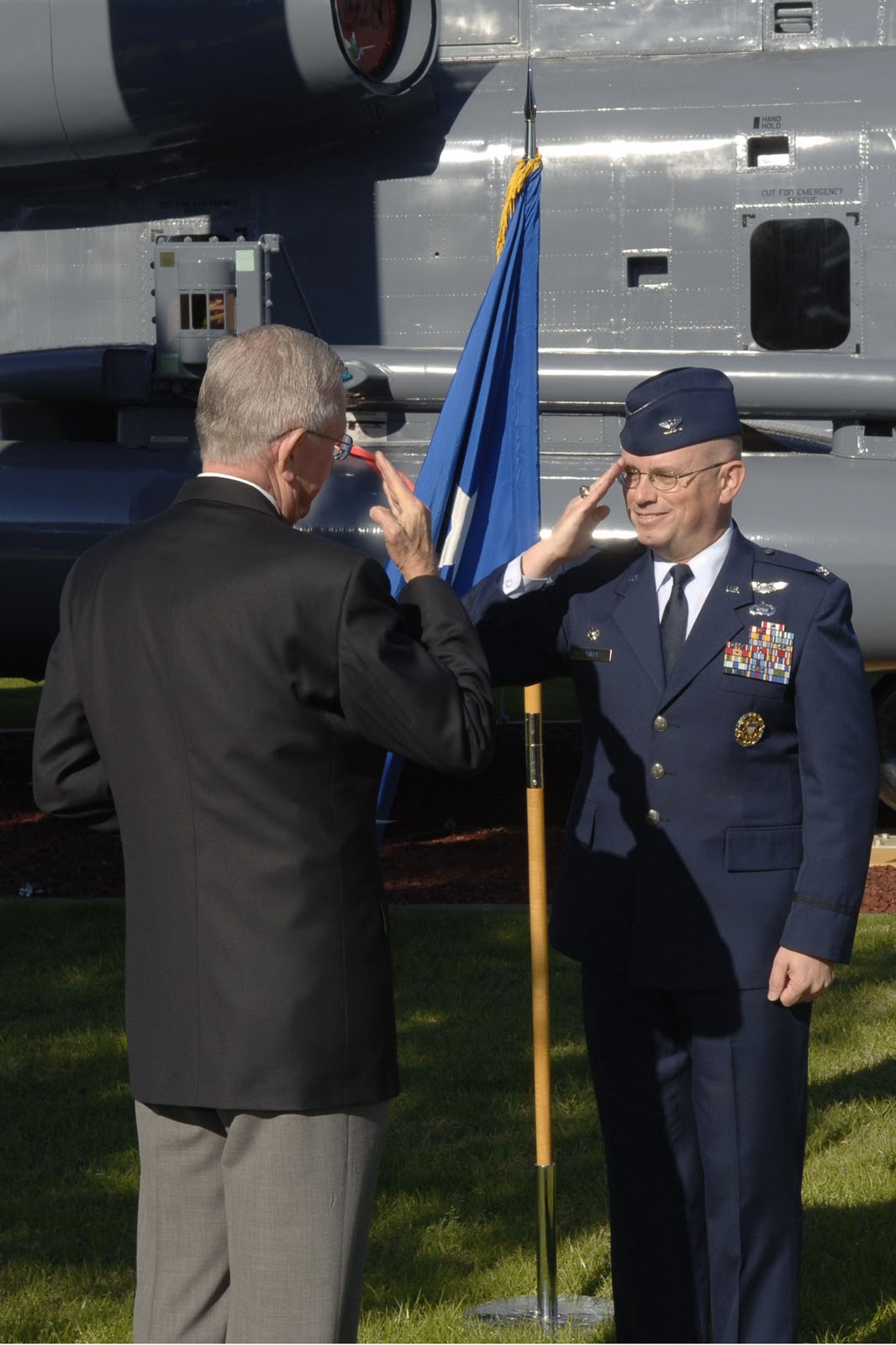
The migrant lifestyle.  One thing we discussed early in our marriage that weighed positively in our plan to wait to have kids was mobility relative to my job.  The plan was that we would have a child at a time that would allow me to retire from the military around the time he entered grade school.  So far, so good--Paul was born shortly before I hit my 21st year of military service, so technically I’m already retirement eligible.  Not that I wouldn’t continue to work, but Steph and I agree that we’d prefer to raise Paul without having to move every two to three years.  Don’t misunderstand though, especially any other military dads reading this.  I absolutely love my career.  In fact I was born into and grew up in a military family that’s spanned more than three generations.  Our desire isn’t one based on a dislike of a the military life or its migrant lifestyle.  For Steph and I it’s more about reducing instability, and moving every two to three years is something we can control.  I’d be less than honest if I didn’t also factor in the impact of temporary duty and deployments in addition to the regular moves.  Opposing this, however, is that I have enjoyed very real benefits that were the direct result of a childhood of chronic moving.  I’m sure for every disadvantage, there’s an equivalent advantage associated with seeing and living in places all over the country and world.  If I retire from the military sooner rather than later, my son won’t share those same benefits.  In the end though, Steph and I are favoring the advantages associated with being less migrant.

Local community.  This would also allow us to settle into a community and establish the associated long-term relationships, especially with the teachers who we’ll entrust to help us educate our son.  Don’t get me wrong; military children tend to do very well academically for a number of reasons.  I suspect in part, this because education is important to military professionals, but even more, because truly global experiences matter and those kids carry that cultural and academically diverse set of experiences right into the classroom.  Socially, it’s not that we don’t have long-term and significant relationships with many of our military friends--we definitely do--but they’re as mobile as we are and most of us won’t settle in the same place once we’re done with our military careers.  Honestly, I hope I can form the same level of intimate and immediate trust with my neighbors once I retire as I have with many of even my most recent acquaintances in the military.  Think about this--every time I move, I instantly have a group of people around me that I would hand my car and house keys to, trust to receive the shipment of all my earthly possessions, and can trust with my wife and son without hesitation.  Amazing since often times I’ve never met many of these people before arriving at my duty station.  I don’t ever want to diminish just how unique and wonderful that kind of community is.
And so here we are, according to “the plan,” within a few years my wife and I should step away from the military life and settle down somewhere a little more permanent.  Two very real things drive me toward what has become an imminent and heavy decision: I’m not getting younger, and I hate spending time away from my son.  The risk of having to spend months or even years away from my son is almost unthinkable.
One thing I’ve learned you can’t anticipate as a first-time dad: the emotional bond that exists between a father and his son.  For my entire adult life I’ve been a career servant of the State.  Now I’m a dad; I’m actually somebody’s dad!  I would give my life for my country and more specifically its citizens and our way of life.  I would also give my life for my wife and son for reasons that another husband and dad would understand, but I think it can be summed up by saying family isn’t the same as country.  And so there’s the tension.  The conflict for my time isn’t binary though.  As mentioned before, I have to work to pay the bills, and to be honest, even if I were independently wealthy, I’d still have to work at something.  All dads can probably identify with the struggle, but I think this struggle is different for a dad depending on where he is in his own life: depending on how old he is.

When I was younger, certainly when I was truly a young man, I remember living the adventure of the military life: working hard, lots of trips, deployments, etc.  I didn’t have kids but many of my colleagues did.  We trained and traveled a lot.  When we were away from home the discussions eventually came around to the things that mattered to us back home; for those of us who had them that meant our wives and kids.  (No offense ladies, but for the first five years of my career, I served in a unit that didn’t have females in combat positions.)  But we were young, and young men are bullet proof and fuller of the stuff that makes us men--energy, testosterone, zeal, idealism, etc.  The body and the brain were young.  (Now, in contrast I feel I have a 20-something year old brain but it’s living in a 46 year old body.)  Those of us who were married loved our wives; those who had kids loved their kids, and we didn’t like being away.  They were our stability and pivot points, but we were young and professional.  We went off to do our jobs.  The travel and work was exciting, at times dangerous, and while it was difficult to be away from home, somehow the adventures also had an equal pull.  For many of us, when we were home we thought about the excitement of being away, and while we were away, our attention turned back to home.
Now something has changed and I think it’s the result of growing older.  I’m not a fan of those guys who always need to tell the bigger story, always trying to one-up their buddy’s adventure or pain, and I’m not doing that here.  But based on my experiences and watching my friends over the years, there’s something different about being a first-time father later, rather than earlier in life.  I can’t prove it, but I think it’s easier for a young man to to balance the family when it comes to the tension between being home and being away from home.  I’m not saying marriage and parenting is easy for a young husband or father, but I think it’s somehow easier when contrasted with his middle-aged colleagues.  Even if I’m wrong and I’m the only one this is true for, I couldn’t have foreseen or understood the difficulty of spending time away from my son.  It’s hard when we men have to spend time away from our wives--if this isn’t the case for you, we probably need to have another conversation--but our wives are adults.  As hard as that is, I think it’s harder to spend time away from our kids--it certainly is for me.  Our kids aren’t adults and don’t understand the reasons for the separation. 

I suppose writing this is therapeutic.  In some sense, I’m certainly writing for myself, to help gel these thoughts and issues in my own mind.  Doing it in a blog though also lets me put a little piece of fatherhood on my sleeve for everyone else to see.  I thought the plan was good and would minimize certain difficulties: money, mobility, etc.  What I couldn’t anticipate is just how difficult it is to look at my small, young son through eyes that are more than 40 years his senior.  I’m convinced it’s a much different and more difficult view than it would have been through those same eyes when they were half as old.  Am I done with my time in the military?  No.  Am I closer to the end than the beginning?  Definitely, and my son has become the primary influence in the decision about when to bring this adventure to a close and begin the next, less migrant one.
Hopefully my words encourage other middle-aged dads and can inform the young men who follow and find themselves wrestling with some of these same thoughts and decisions.  Finally, maybe a few wives and even kids can be encouraged to know your men wrestle with these kinds of things.  We are men, with all the associated confusing, irritating and cool baggage it brings for those around us.  For many of us, the crusty exterior is there for all the right reasons:  to some extent, it’s the way we’re wired; but also we may need it to fuel the things we need to do at work.  Fortunately or not, those two realms within our lives aren’t binary and can’t just be switched on and off.  Regardless of the appearance on the outside though, these things still rage within us as husbands and fathers. 
It’s great to be a dad!

Sunday, December 5, 2010

Book Review: The Compleat Gentleman

The Compleat Gentleman: The Modern Man’s Guide to Chivalry (Revised and Updated) by Brad Miner (Richard Vigilante Books, 2009)

In this wonderful book, Brad Miner rolls an incredible volume of history and research into a single reference about chivalry, then applies it to modern times and modern manhood.  The book generally has an academic tone to it, but not in a way that’s distracting.  In fact, for what is essentially a combination of history and what today would be called “self-help,” the book is definitely readable and held my attention throughout.
Miner works us through the picture of the compleat gentleman by discussing the medieval knight (often used to typify gentlemanly behavior), then examining three persons as models or types:  the warrior, the lover and the monk.  He also distills the essence of the gentleman into a single Latin concept: sprezzatura, which he thoroughly examines throughout the book due to its rich, deep and complex meaning.  On the surface though, it simply means nonchalance; Miner says that to today it would mean “cool.”  Toward the end of the book, he summarizes his work by saying, “if ‘honor’ is properly the one word that epitomizes the character of a gentleman, then ‘sprezzatura’ is the last work about the gentleman’s ‘conduct of life.’”  He goes on to say, “There are two ways to look at a fellow’s sprezzatura.  On the one hand, it means discretion, or, more grandly, prudence; on the other hand it means restraint, which may even be concealment.”
As you read, Miner will weave these concepts together with others, including the role of historic stoicism, and leave you walking away challenged and encouraged that no matter who you are or where you think of yourself relative to gentlemanly conduct, you’ll can make more of yourself.
At the end of the book, Miner quotes Rudyard Kipling’s poem “IF” (available through The Kipling Society at http://www.kipling.org.uk) as his closing and as “the best short summary of the compleat gentleman’s profession.”  If you’re not familiar with Kipling or this poem:

If you can keep your head when all about you
Are losing theirs and blaming it on you;

If you can trust yourself when all men doubt you,
But make allowance for their doubting too;
If you can wait and not be tired by waiting,
Or, being lied about, don't deal in lies,
Or, being hated, don't give way to hating,
And yet don't look too good, nor talk too wise:

If you can dream – and not make dreams your master;

If you can think – and not make thoughts your aim;
If you can meet with Triumph and Disaster
And treat those two impostors just the same;
If you can bear to hear the truth you've spoken
Twisted by knaves to make a trap for fools,
Or watch the things you gave your life to broken,
And stoop and build 'em up with worn-out tools:

If you can make one heap of all your winnings
And risk it on one turn of pitch-and-toss,

And lose, and start again at your beginnings
And never breathe a word about your loss;
If you can force your heart and nerve and sinew
To serve your turn long after they are gone,
And so hold on when there is nothing in you
Except the Will which says to them: "Hold on!"

If you can talk with crowds and keep your virtue,

Or walk with kings – nor lose the common touch,
If neither foes nor loving friends can hurt you,
If all men count with you, but none too much;
If you can fill the unforgiving minute
With sixty seconds' worth of distance run,
Yours is the Earth and everything that's in it,
And – which is more – you'll be a Man my son!


Finally, a note for those who might mind, the author clearly writes from a Catholic perspective and defines himself as a classic liberal.  Even so, he’s never in your face with either and the points about being a gentleman don’t conditionally rest on either.  No matter what your religious or political persuasion, the book is informative and useful.
The Compleat Gentleman is definitely worth the time to read.  If you have an interest in the history of gentleman and chivalry, the book is a great anchor point for additional research, with plenty of references and a healthy selected bibliography.  I recommend this book to any man whether he’s a father or not, think it would make a great gift at the appropriate time for any young man, and will definitely be on my son’s reading list.
It’s great to be a dad!

Tuesday, November 30, 2010

A Day of Firsts

Steph and I love that here in Germany, kids start kindergarten when they’re three: with an actual curriculum and structure to the time.  Monday, the 15th of November was a day of firsts in our household:  one big and one just noteworthy and funny.  The big event was that Paul started kindergarten and he loves it.  We were eager to have him start at a local (German) private school and we finally came up on the list.  The school is awesome.  It’s small and balances the number of international students with German students.  Besides the obvious social skill development he’ll get, one of the things we want for him is immersion in the local language and culture as much as possible.  Last week, running up to our American holiday Thanksgiving, the school asked Paul if he wanted to draw a picture of something he’s thankful for.  He said he wanted to draw a motorcycle.  I’m not sure why he picked a motorcycle, but I’m okay with it--neither Steph nor I are anti-motorcycle folks and it seems these are one of a number of things that tend to capture the imagination of young boys (at least our boy), along with space ships, airplanes and robots.  From his very first day of school, Paul can’t wait to get there and when we pick him up, he’s all talk about what he and his friends did that day.  He loves going and we’re happy he’s having such a great experience with the beginning of a lifetime of learning.

The other first?  Well, I recently converted Paul’s toddler bed to what he calls his “big boy bed.”  It’s still a toddler bed, but I took the low rail off the front so that his entry and exit isn’t constrained.  Neither is he when he tosses in bed at night.  We went a week or two without incident, then early Monday morning (the day Paul started school), we heard the thud:  the distinct sound of his small frame hitting the floor.  It went like this:  thud...about five seconds...crying.  He was fine other than the tumble surprised him and woke him up.  Steph and I were already on our way to his room during the short interlude between the thud and the crying.  The funny thing about it was when we stepped into his room, he was laying on his bed.  We asked him what happened, not completely sure since he wasn’t on the floor.  He told us he hit his head.  At that point I wasn’t sure if he fell out of bed or not.  We asked him where he hit it and he said, “on the floooooor.”  It warmed and broke my heart at the same time.  Falling out of bed is one of those rights of passage.  Apparently when he hit the floor, he used some superpower to leap back into bed in the two or three seconds before we were in his room--the boy is fast!  It made me think, though, that he thought he did something wrong.  A little love and snuggling later, he was back asleep.  I left for work a short time later and he slept just fine until Steph woke him for that big, first day of school!
It’s great to be a dad!

Friday, November 26, 2010

Thanksgiving 2010

Thanksgiving is an awesome holiday.  I definitely appreciate its origins, tracking back to the early American settlers and their thankfulness to God for what he provided.  I also appreciate the holiday has broadened to something much more than remembering their thanks, or being thankful for the same things they were.

This Thanksgiving, these are the things I’m most thankful for:
  1. My wife and son.  They’re happy and healthy, and keep me the same.  There aren’t words to capture the privilege and honor it is for me to be a husband and father to these two, the most special people in the world.
  2. My parents:  all of them.  First for my mom & dad (who aren’t together any longer), and their spouses.  I love and respect them all!  Second for my wife’s parents who, for as long as I’ve known them as an adult, have treated me like their own son.  (It’s a long story, but my parents and Steph’s parents have known each other since Steph and I were larvae.  This marriage just might have been arranged...)
  3. My sisters:  all four of them.  Two of them are married and their husbands are like brothers to me.  One is single (HA!  I don’t have to share you, Sissy!), and one is no longer with us.  (I love and miss you, Galyn.)
  4. My grandparents, who will never know just how much they helped make me the man I am.
  5. Jess and Will.  Jess, you’re like a daughter to us, and always will be.  You married a great guy and we’re so happy to see your family growing!
  6. My ability to work and provide for my family, and to make enough to be able  share what we have with others--financially and materially.
  7. My country and the privilege of serving her.  I get as frustrated as anyone else over some of the things we do as a nation, but I’ve traveled the world and remain unashamedly thankful and proud to be an American.  Related, I’m humbled and honored to serve among and alongside my military colleagues.  I am lucky enough to have spent nearly two and a half decades serving with and standing among some true and amazing heroes.
  8. My job, that pays me to live in places for years at at time, with my family that other families save for a lifetime just to visit for a few weeks.  And many others only dream of such travel and never make it.
  9. For the last couple years, living as a friend, peacefully in a country that my country used to be at war with.  Germany is fantastic beyond words.  The land and climate are amazing and the people are some of the best I’ve met anywhere in the world.  My German friends are dear to me and I’m humbled to be counted a friend by some of them.
  10. Imagination: mine, my wife’s, and my sons.  I love seeing my son’s mind racing so fast and in so many directions--unconstrained to the best of our ability.  My parents allowed, and even fueled, my imagination and I’m doing my best to pass that kind of freedom on to my son.
  11. My friends, some tied to my career and others who aren’t, who are always with us thanks to modern technology.  You all are a huge part of what keeps me and my family going strong and doing the things we do.
It’s great to be a dad!

Tuesday, October 19, 2010

Imagination

One of the things I love most about being a dad so far is watching my son’s imagination develop.  I try to encourage it.  The results at times have sprung out of the blue when some crazy, cool new demonstration of imagination just appears.  The other night Steph and I were eating pizza for dinner and decided to sit in the living room instead of at the table to catch a show we rarely get to see.  Suddenly Paul starts humming music from the Star Wars movie “Return of the Jedi.”  The tune was from the scene when the Imperial Dreadnought “Executor,” crippled by a rebel Y-Wing, crashes into the unfinished second Death Star.  We looked up and his slice of pizza had become the Dreadnought and his plate was the Death Star.  But this wasn’t our imagination interpreting what he was doing; we asked him and he told us, “it’s crashing into the Death Star!”  Thankfully the camera was handy.

Steph and I clearly started and continue to encourage his fondness of Star Wars (and all things SciFi), but this was the first time we saw him apply is imagination in this way.
Traditional Blocks
A year or so ago we also bought Paul a basic set of building blocks.  You know the ones: a simple variety of colors and basic shapes: cubes, rectangles, wedges, cylinders, and planks.  Usually small buildings or garages emerge so he can drive his toy cars and trucks around them.  Then one day he built a tower--one that we didn’t have to pretend looked like one.  Paul even took a couple toy men and put them on and around it.  They were mediaeval knights standing guard to defend the tower from attack.  It was a good, strong tower, built on the stone cliffs of...the coffee table.  Of course, no tower is complete without a dragon, and as you can see Paul was happy to play the role.

The tower withstood relentless attacks for what must have been an appropriately long time in Paul’s mind, and then its walls fell.  I suspect the cool thing for any boy who gets to be the dragon is that he gets to destroy the tower when his imagination drives him on to another adventure.  Certainly that’s better and much more fun than the alternative--Steph or I getting tired of having it in the middle of everything and putting it away for him.
LEGOs
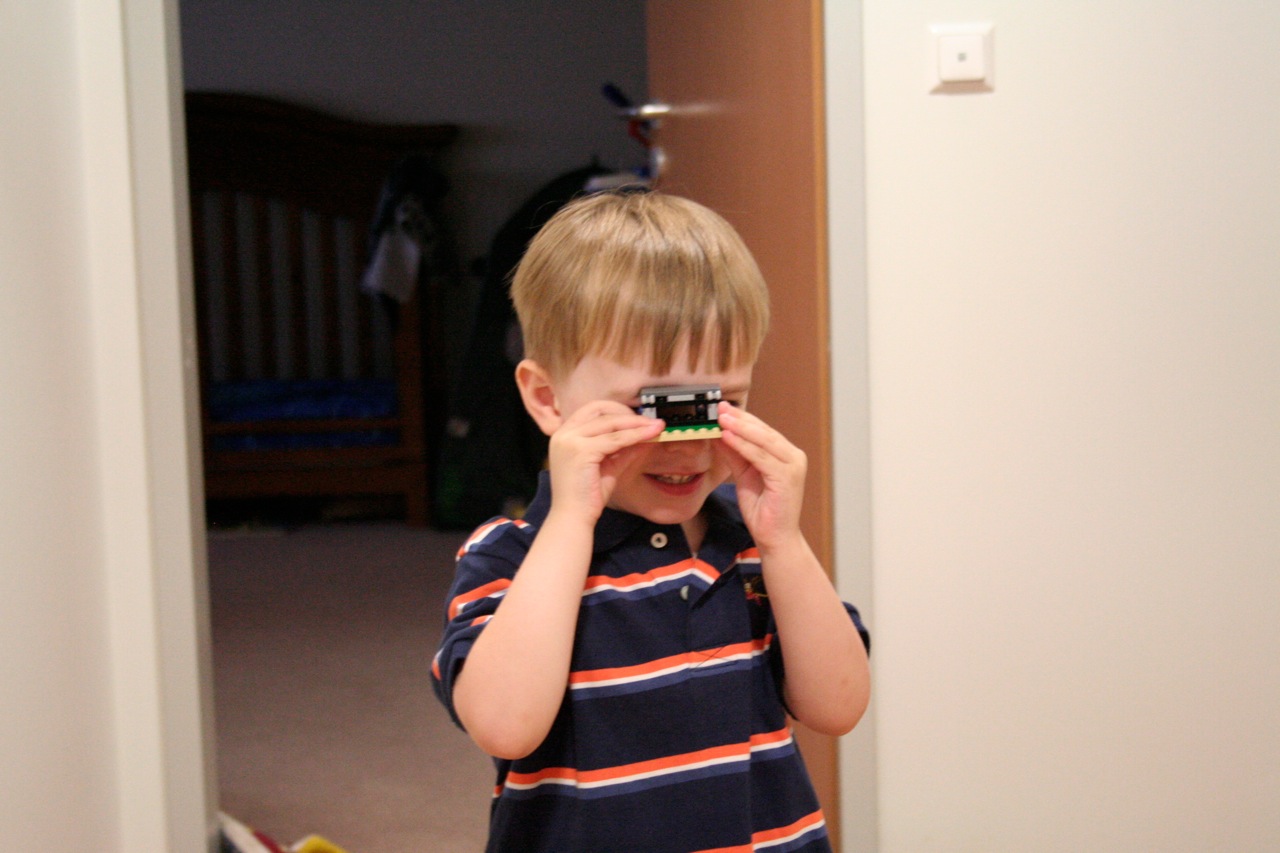
Paul has a growing collection of LEGOs; a childhood staple for kids since prehistoric times.  His consist of an assortment of basic building blocks, and some of the Star Wars kits (of course).  While the Star Wars kits don’t usually lend themselves to a lot of creative building at this point, he’s always playing out scenes from the movies as well as new scenes from his own imagination.  Every now and then, the custom parts do lend themselves to something entirely not Star Wars related.  The basic building blocks, however, offer his young mind a clean slate.  Like kids everywhere, if he can imagine it, he can try to build it.  The first time he did this with any real accuracy and success was when he built himself a tiny camera, complete with viewfinder and a button to push to take the picture.
Paul is also a fan of Dr. Who.  If you’re familiar with the show, you know there are episodes we don’t let him watch, but he’s seen many of them and regularly asks to see more.  What sticks with him from these shows are the Doctor’s Tardis, and the Daleks, and the LEGOs help fuel the imagination here just like a dinner plate and pizza did for Star Wars.  From LEGOs, Paul has built a pretty amazing Tardis or two!
Everything in the house is potentially useful and we try to encourage him to see things differently than what their obvious purpose is.  As I was drafting this, Paul came in and told me, “I did it!  All the robots have matching heads!”  I followed him into the hallway to find out what he was talking about.  Who could have known that an empty case of beer bottles set by the door to go back to the getränkemarkt were actually a bunch of robots.  He had taken the time to swing all the stoppers back up to the top of the bottles, turn them upside down and set them on top of the bottles.  They’re robots, and why not?

What’s next?
Of course, we’ll keep expanding the LEGO collection by increasing the size of the basic pieces.  This Christmas we’re going to introduce him to another imagination fueling toy:  a basic set of Lincoln Logs.  Who knows where these will take him, and take us through his active imagination.  I can’t wait for the ride!
It’s great to be a dad!

Sunday, September 26, 2010

Book Review: Fathers and Sons

Fathers and Sons: 11 Great Writers Talk about Their Dads, Their Boys, and What It Means to Be a Man (Esquire Books (Hearst))

This is a short and wonderful book of essays about fathers and sons, edited by David Katz.  As a father and son, the collection brought me through moments of laughter and sorrow, excited identification with the contributors, and occasional dread.  Not every essay resonated with me, but I think it’s a testimony to the good work Mr. Katz did in representing a breadth of views and experiences on the topic.  The final essay is a daughter’s view of her dad; I’m glad it was included.  I recommend this book to the fathers out there, or if you have a father or son in you life.  In other words, it’s worth the time to read regardless of who you are.  It’s certainly a good read for anyone who has interest in parenting, fatherhood and the associated first-person perspectives of the father-son relationship.
Swing by your favorite bookstore, local or on-line and grab a copy.  Toss it in your briefcase or put it beside your bed for a few minutes of reading each night.  I think it’s a worthwhile addition to your bookshelves.
It’s great to be a dad!

Tuesday, September 7, 2010

RESTREPO: Movie Review

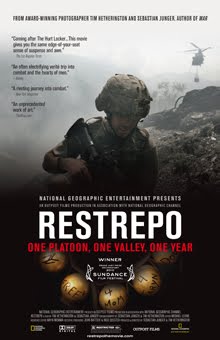
There are a number of movies I intend to watch with my son as he grows older, to reinforce a variety of life’s lessons.  Some are general while others specifically focus on being a man.  I recently saw National Geographic’s documentary film RESTREPO.  It’s now on my list of films to watch with my son, and it’s a film I highly recommend to you, especially if you’re not in the military.

The film follows a platoon from U.S. Army’s 173rd Airborne Brigade while deployed to an outpost in Afghanistan’s Korengal Valley, Kunar Province, Afghanistan from 2007 to 2008.  The name of the outpost and title of the film come from the platoon’s fallen medic PFC Juan Restrepo. 

(Outpost (“OP”) Restrepo. Korengal Valley, Kunar Province, Afghanistan. 2008. A film still from the documentary RESTREPO by Tim Hetherington and Sebastian Junger. Image © Outpost Films)
The film is not political, nor does it take a stand on the U.S. military or military service in general.  The purpose appears to be to give a raw human view of this kind of combat deployment, including the associated highs and lows.  The experience is visually stunning, intimate and very human as you see a one-year combat deployment digested into 90 minutes.  It’s very well done.
From the film’s website, its directors Tim Hetherington and Sebastian Junger state:  “The war in Afghanistan has become highly politicized, but soldiers rarely take part in that discussion. Our intention was to capture the experience of combat, boredom and fear through the eyes of the soldiers themselves. Their lives were our lives: we did not sit down with their families, we did not interview Afghans, we did not explore geopolitical debates. Soldiers are living and fighting and dying at remote outposts in Afghanistan in conditions that few Americans back home can imagine. Their experiences are important to understand, regardless of one's political beliefs. Beliefs are a way to avoid looking at reality. This is reality.”

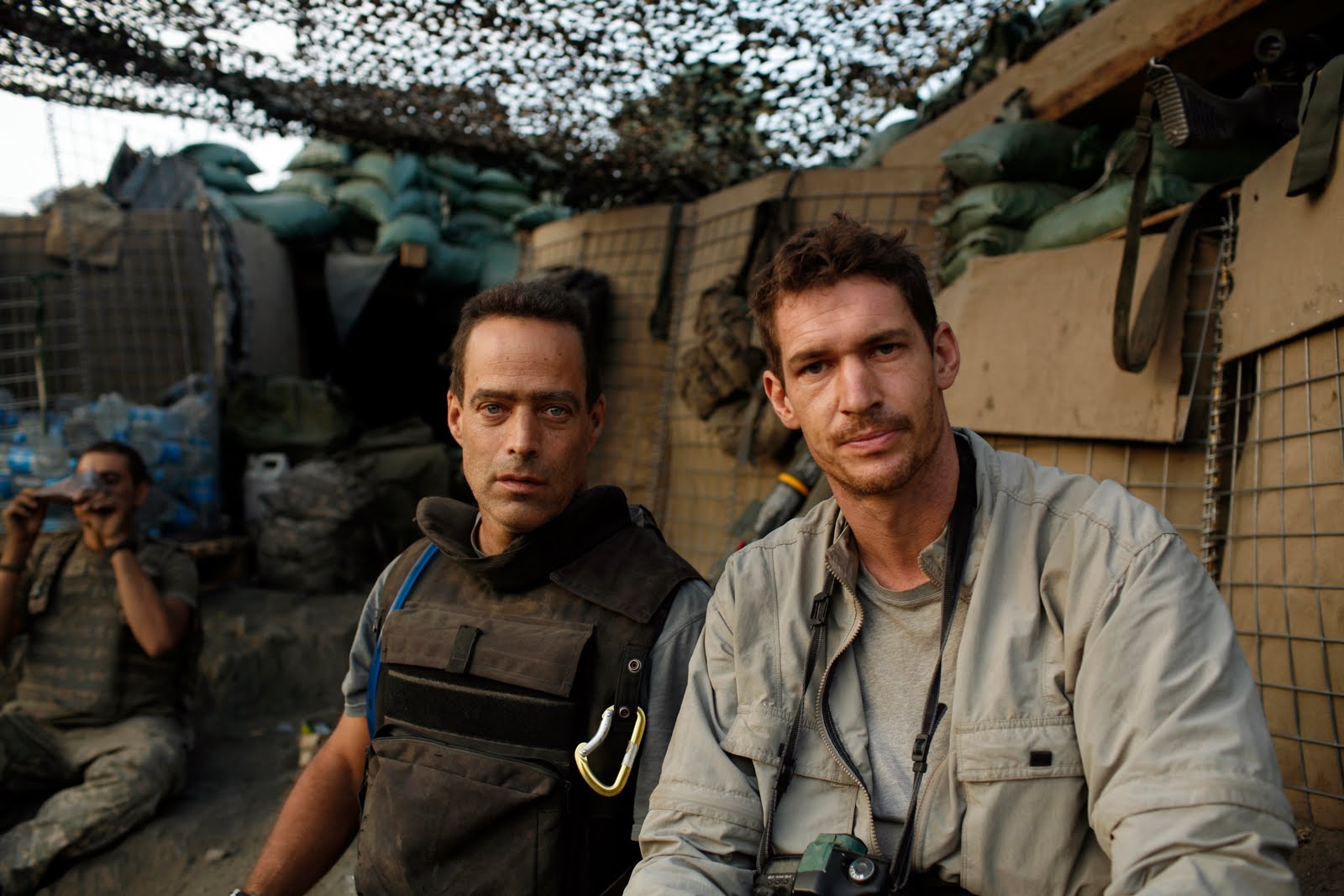
(RESTREPO filmmakers Sebastian Junger (l.) and Tim Hetherington (r.) at Outpost Restrepo. Korengal Valley, Afghanistan, Kunar Province. 2007. Photograph © Tim Hetherington)
What about your kids?  You know your kids better than anyone, but my recommendation is not to take children under 17 to see this.  While the movie isn’t necessarily gory, it is a war movie.  It’s not a depiction; it’s a documentary, and it’s violent.  The violence, however, occurs in an appropriate context (it’s not violence captured on film simply for the purpose of sensational violence) and the film is very respectful of the soldiers and families involved.  What will make the movie difficult for kids, especially young ones, is viewing the movie without an appropriate understanding of the broader real-world context of the war in Afghanistan, or the decisions that led us to the war--again, not really a part of what the movie attempts to address.
For older or more mature kids, it may be a great teaching tool to help them know and understand any number of broader things:  courage, duty, service to country and friends, loyalty, bravery, decision-making, the practical impact of political decisions, as well as other attributes that we parents hope to see instilled in our kids as they mature into adults.  Overall, I recommend parents see the movie first, then decide if it’s the kind of film your kids should see.
For more information and to see the trailer, visit the film’s website (http://restrepothemovie.com) and National Geographic’s “The Making of Restrepo” (http://movies.nationalgeographic.com/movies/restrepo/junger-hetherington)
I highly recommend you see this movie no matter what your political views, your views of the military, or the war in Afghanistan.  It’s an amazing snapshot of what one facet of modern ground warfare looks like: dramatically different than that of previous wars up to and including the war to liberate Iraq.  More importantly, it’s also an amazing chronicle of the bonds that form between men, in this case men who became friends as they trained together and later fought side by side.
It’s great to be a dad!