Monday, June 21, 2010

My Dad

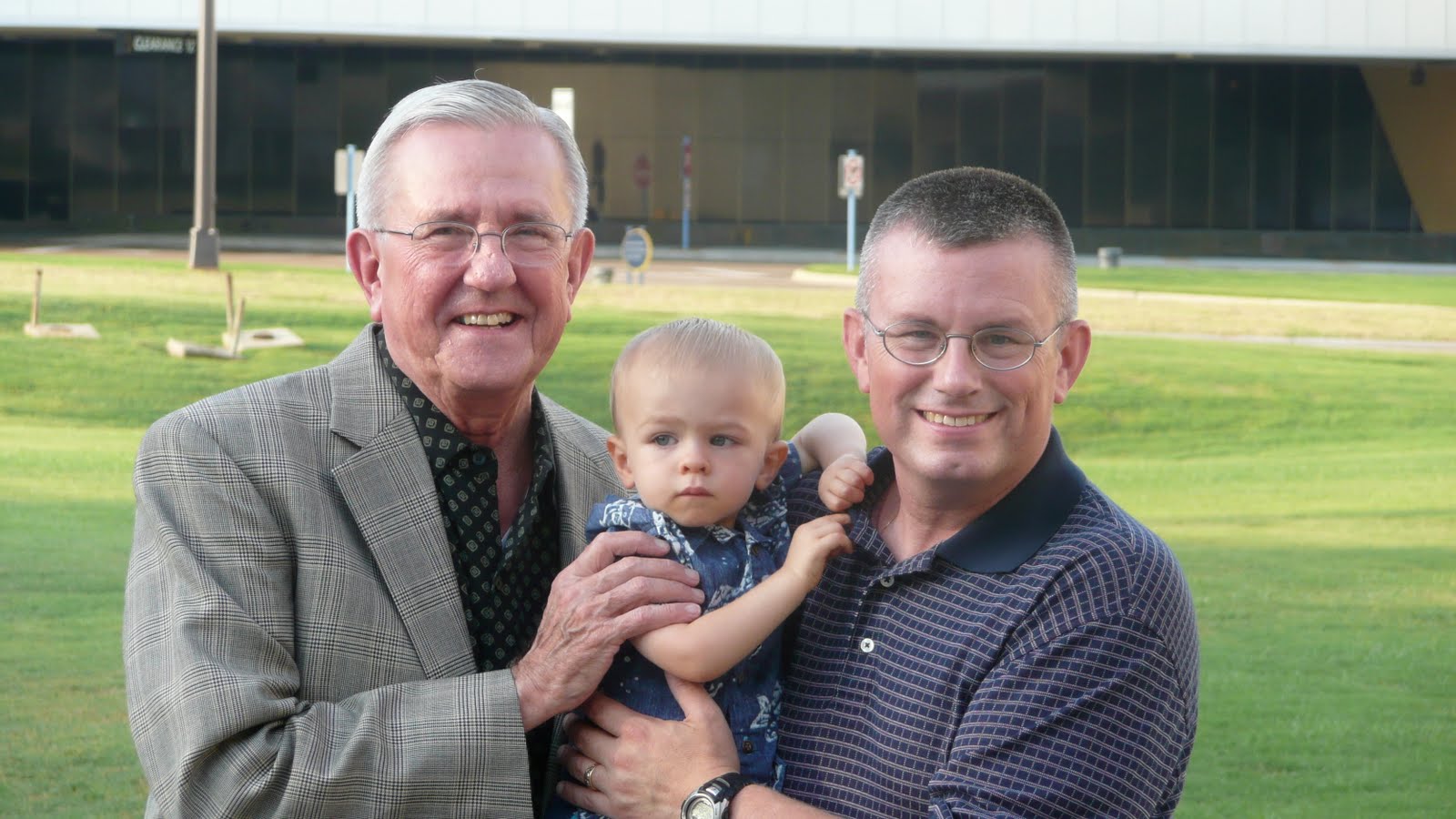
My dad is one of my heroes.  This Father’s Day I want to honor him by explaining to a limited extend what he’s contributed to my being the man and father I am today.

Here’s his story:
Dad was born in Salt Lake City, Utah in 1937, the son of a salesman for what was the American Chicle Company.  One of his earliest memories was from when he was a little guy (probably only two or three years old).  The family lived on the third floor at the time and dad would often play in or near the window when he couldn’t be outside.  The window washers had come by but failed to put the screen back tightly.  When dad climbed up to play, he fell out the window.  His grandmother (called “Nan”) jumped out the same window after him and as Dad recalls, somehow she seemed to get to the ground before him or at nearly the same time in order to try to protect him from the fall.  Fortunately he fell into a clump of bushes below the window and wasn’t harmed.
In 1941 when he was about four, the family moved to Dallas, Texas where my grandfather was promoted from salesman to District Manager.  At that time, as the US entered World War 2, my grandfather volunteered for and was inducted into the Navy and attended Officers Candidate School.  Around that same time, my dad’s grandmother back in Salt Lake City was going blind.  As a result, the Navy sent my grandmother, dad and uncle back to Salt Lake to be with her.  The Navy paid for the travel and sent them on a troop train; that was my dad’s first exposure to the military, riding the train with the troops who were making their way to the war.  Shortly after arrival, it was clear Nan was completely blind.  At that time, my grandfather was the head of household and the sole provider for the family.  as a result, the Navy exempted him from service and the family (including Nan) moved back to Dallas.
When dad was first in grade school, his older brother Neil was supposed to walk him home.  Neil just walked home alone and left dad at the school.  Dad found his way home alone, even though he doesn’t remember how he found the house.  Neil took a beating.
As a boy and young man, dad always had chores to do.  One particular chore that still sticks vividly in his mind was mowing the grass.  My dad and uncle were both young, dad wasn’t tall enough to reach the lawn mower’s handle, but my uncle was.  As a result, my uncle Neil was allowed to push the mower.  There was also a rope tied to the mower that my dad used to walk in front of the mower, pulling it along like a plow horse.  When the grass didn’t need mowing, there were always other chores to do: painting the house, mending a fence, etc.  It was clear to my dad (as unenjoyable as it was when he was a child) that he was expected to put the family first and that everyone in the family was expected to contribute for the greater good.
His first real job was as a paper boy in Dallas when he was 9 years old.  As was normal for the day, he would go door-to-door to collect directly from the customers once a month.  From that money, he would pay for the newspapers, with his profit coming from any additional money or tips collected.  From what profit he made, my grandmother allowed him to keep $5 a month; the rest went into the house fund to cover other family needs.
The family moved from Dallas to Cleveland, Ohio in 1951 where my grandfather was promoted again, now to Division Manager.  This was early in the Korean War and dad has vivid memories of lots of radio chatter about our military and the war.  Cleveland became home for the rest of his youth and it was there that he completed 8th through 12th grades. 
When he was 13 years old he took an all-summer job washing dishes at the Centerville YMCA Camp in Ohio.  His first summer there he was still short enough that he had to stand on two Coke-a-Cola crates to be tall enough to wash the dishes.  His work ethic impressed his manager there and as a result, he was able to work other jobs too, including in the craft shop and eventually as a life guard, all under the oversight of the same manager.  His experiences at camp were good ones, it earned him some money, and it got him out of a full summer of chores at home.  He continued working for the next five summers, through graduation from High School.
As was typical of the time, since he didn’t have a car he hitchhiked to get to and from camp, even to return home in the middle of the summer when he had a few days off.  His last summer there, the summer after he graduated from HS, his brother Neil had joined the AF and dad wanted to have his brother’s Buick.  Grandpa wouldn’t give it to him and instead said he could have it if he bought it.  Dad paid $100 and bought his first car.  What was noteworthy about that final year Dad had accelerated through HS and completed school in February.  As a result, he worked for my grandfather from February until the summer.  That summer before college started, probably to avoid more chores around the house for no pay, he went back to the YMCA camp.
He graduated from John Marshall High School, having lettered in track all four years, and applied to attend Miami University of Ohio.  Miami was co-ed university and known for its business school.  It was a feeder school for Harvard’s Business School, and as such was the only state school in Ohio that required prospective students to take entrance exams.  Dad was accepted and also decided to enroll in ROTC.
As a freshman, he pledged for ΣAE and was accepted into the fraternity.  That year though, he and his group couldn’t be inducted because the fraternity was in trouble and on probation with the National Chapter.  Dad and about 30 other classmates decided to wait the probationary period out and join when they could.  (Other students apparently didn’t wait and went on to other fraternities.)
At that same time, his brother was studying to get into medical school and due to his circumstances, needed to pursue a masters degree first to prove himself.  As a result, most of the available money in the family went to pay for his college bills rather than my dad’s.  My grandfather paid for dad’s first year, but that was it.  Dad wanted to continue college and ended up working four jobs to pay his room, board and tuition: as a waiter in  one of the women’s dorms, as a burger cook and waiter at the fraternity house, and as a salesman at a local clothing store.  He finally worked his way through to graduation in June 1959, received a business degree and a commission in the US Air Force.  His dad congratulated him for working his way through college and asked him what he wanted.  Dad said he wanted a car, preferably a convertible.  Grandpa asked him if he’s like one of those new Impala convertibles, dad said yes.  Grandpa picked the car up and dad thanked him for such a nice gift.  Grandpa then told him it might not be such a good deal and to look in the glovebox.  In the glove box, dad found the payment book for the car.  It wasn’t intended, but dad had just bought his second car, thinking it was a graduation gift.
As I mentioned, dad was in ROTC all four years of college.  He wanted to join the AF to be a pilot, figuring he could serve his country for several years, then shift into the commercial aviation world as an airline pilot.  He took the exam to see if he qualified to compete for a pilot training slot and earned his private pilot’s license, at the time a requirement to gain a pilot training slot with the AF.  He scored well and with a private pilot’s license in hand was selected to attend pilot training after commissioning.
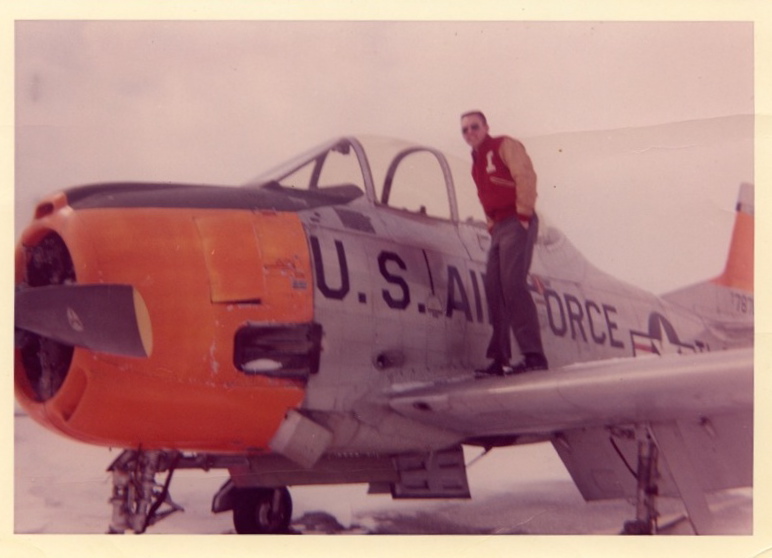
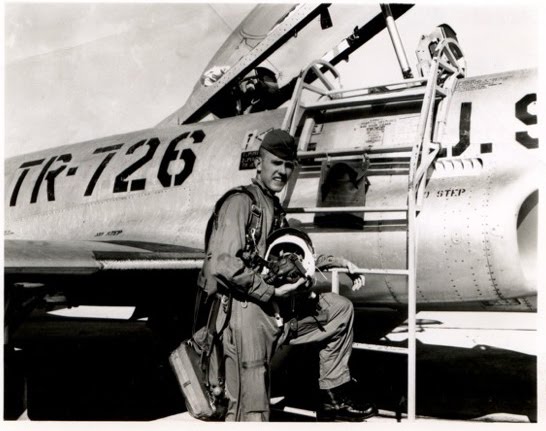
In December 1959 he reported to Lackland AFB for what was called officer preflight training.  After successfully completing preflight, he continued to Malden AB (Malden, MO) for primary flight training where he flew the T-28 and was in the last class to fly this reciprocating engine aircraft for primary (pictured above), then at Laredo AFB, TX where he flew the T-33 to complete pilot training in a jet aircraft (pictured below).  After graduation and with survival and passing through the Technical Training Unit, he began flying C-133’s as an airlift pilot.  Throughout his career he flew C-130s, C-141s and C-5s as well as other assorted aircraft.
During the early part of his career, he was also selected along with 125 pilots from across the AF to screen for the astronaut program.  He passed the grueling 9 day physical, but ultimately wasn’t selected to complete the training since he didn’t have an engineering degree.  His name was kept on the books as eligible, but he was never called upon to enter the program.
He served in combat in Viet Nam, commanded at the squadron, group, wing and twice at the air division level, and also served as the Technical Training Center Commander at Keesler AFB, where he retired in 1991.  One of the Air Divisions he commanded, the 76th Military Airlift Division at Andrews AFB, MD, included three subordinate wings, one of which was the 89th Military Airlift Wing responsible for presidential and congressional airlift, including the US’s most famous jet: Air Force 1.
His original plan to move to the airlines after a few short years flying for the military was overcome by his love for military aviation and those few short years became a 32 year career.  Along the way, while working a full-time career in the Air Force, he also earned an MBA on his own time.  He retired from active duty as a major general and transitioned to civilian life.
Shortly after retirement, he was hired to tech MBA studies at William Carey College in Hattiesburg, MS.  Around that same time he also ran for Congress against the incumbent for the 5th Congressional District in Mississippi.  The incumbent won but the visibility and desire to continue in public service was noted.  As a result the State of Mississippi asked him to become the first executive director of the newly formed Mississippi Gaming Commission in September 1993--the year the State Senate voted to legalize and regulate casino-style gaming in the state.  He accepted and ran the State’s gaming compliance arm for almost six years until sometime in 1998.
Shortly afterwards, he was offered the position of President and CEO of a financially struggling Signature Works (the largest company in the world employing visually impaired workers).  He served with them for two years, moved the company back into the black, then handed a healthy company to new leadership.  Never content to sit still, he then started a company with two other men to store cars for military members stationed overseas or deployed.  That same year he also started his own company, PDH Associates, to assist individuals and companies who desire to enter into the gaming industry.  Since then he’s taken a number of corporate governance positions within the gaming industry, including a position on the Board of Directors for the Riviera in 2001, and as the President and CEO of Pearl River Resorts, working directly for the Meko (Chief) of the Mississippi Band of Choctaw Indians.  He still lives in Mississippi today and actively continues with his own company, as well as with Pearl River Resorts and the Riviera.
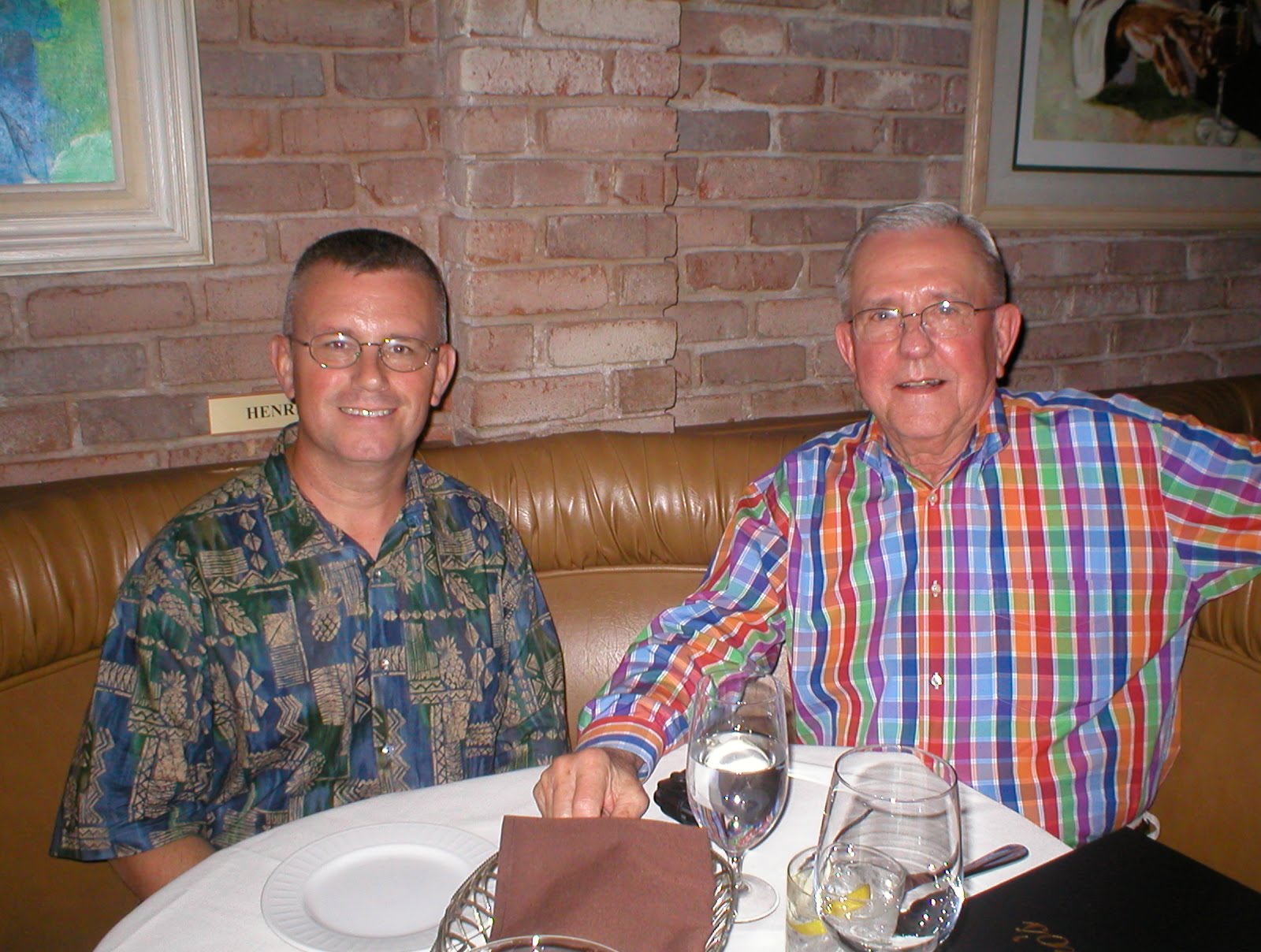
Dad, I want you and others to know what you taught me: the things I can say you’re responsible for teaching me and that have made me the man, and the father that I am.
  • Serving others and your country is more important than serving yourself
  • Work hard and provide for your family
  • Be a team player but don’t expect others to carry your load
  • Be generous with what you have and help others when you can
  • Education is important--get as much as you can
  • Discipline will get you through most everything in life
  • Priorities matter--commit to and finish what you start
  • Have a sense of humor--don’t lose it and don’t forget to laugh
  • Don’t forget where you came from--it matters because it makes you who you are
There are so many more things I could say, but these are the big ones.  You didn’t just tell me these things, you taught me through your words and deeds across my entire life.  You also commissioned me as a second lieutenant in the US Air Force, officiated all of my promotions, greeted me when I returned from my first combat deployment, and my son is named after you.  Thank you for being my dad and my hero.  If I’m ever even half the man that you are, I can count my life a success.  Happy Father’s Day, dad.  It’s truly great to be your son, and as always,
It’s great to be a dad!

Saturday, June 19, 2010

Father's Day Guest Post: For Dad

This post was submitted by Kristina, a military officer and colleague of mine, in honor of her dad.  He recently passed away.  She penned these words on September 24th, 2009 and shared them at his funeral.  It seems appropriate to post her words, unedited, for Fathers Day.  Read on as she honors her dad:

I just wanted to start off by saying that Dad asked me to do this a couple of weeks ago. I knew it would be hard, but how could I say no? Dad also asked me to talk about what he meant as a naval officer. Unfortunately, I didn’t really know him when he was a naval officer, so I’d like to defer to (my Dad’s friend), who’ll be following me.
I don’t think Dad would have asked me to do this ten years ago. When I was about 16/17, we weren’t exactly on speaking terms. Before and after that rough patch, however, is a different story. I remember he was an assistant softball coach on Melissa’s and my team; he was an enthusiastic homework tutor, a motivator, and a supreme public embarrasser; in fact, when we went food shopping, he loved to dance in the middle of the supermarket just to see me turn multiple shades of red and hear me squeal, “Da-ad! You’re embarrassing me!”
Melissa, my sister, was a Daddy’s girl. Once, when Melissa was three years old, Dad was shoveling snow outside. Melissa put on Dad’s Navy uniform jacket and cover (aka his hat), walked outside to the front stoop, and exclaimed, “Daddy! I’m just like you! I’m in the Navy, too!” Laughing, Dad swooped Melissa up, and Mom took pictures.
I know Melissa will agree that we enjoyed being world travelers together. We lived in and traveled all over Europe and the US. Dad loved to show us great sites and teach us the way things worked – the cable cars in the Swiss Alps, for example.
Dad and I would have long conversations. I could always count on Dad for deep conversations on religion, science, and the meaning of life, among other topics. We concluded that there must indeed be life on other planets, and that Moses really did part the Red Sea. In fact, our last real conversation was on death as a journey, which I’ll get into later.
Last month, I wrote a prayer for my family in my journal, and read it to Dad when he was in the hospital. He loved it. I thought I would share it:
Written Aug 20, 2009:
"My dad has Stage 4 cancer. He hasn’t had a job in over two years…
[I also spelled out a few details about my other family members]
Please, God, help my family. Don’t worry about me – I’m fine – I’m doing great actually. Please cure my dad’s cancer. I know he’s been a smoker for 34 years, and he shouldn’t have done that – but could you spare him anyway? [More about other family members]
God, I know this is an extremely tall order, and I know I’ve said this before, but if you grant me these things, I’ll never ask for anything again – I mean it this time…
I’ve never written down a prayer before."
Dad was crying after I read him this prayer on the phone. And it’s kind of funny, in the weeks after that prayer, I found myself sometimes slipping and asking God for something, and immediately afterwards I would say, “Just kidding, God! I take it back! I’m not asking for anything else like I promised I wouldn’t!”
I read parts of the Bible several times during his last weeks with us. His favorites were Psalm 23 and Corinthians. My favorite is Corinthians. I also prayed with him. He really liked that.
I also thought I would talk about my last real conversation with Dad; it was on the 15th of Sep. Dad was in good spirits, eating some of the dark Swiss chocolate I had gotten him. Dad started saying he wasn’t sure what death was going to be like. I asked him, “Are you afraid?” 
“No, I’m not afraid” he said. “I just don’t know what to expect…I’m curious.” He said that he felt like he would get to heaven and then ask, “Now what?” He said that all of his faiths led him to believe in an afterlife. I told him a story where a friend of mine had seen his grandfather attend his own funeral. “Oh yeah?” Dad asked – I think he liked hearing that.
I finally gave him the book on death that the hospice nurse had given me a few days before. (I had been hiding it from him.) The name of the booklet was “Gone From My Sight.”
“What a bad title for a book!” Dad joked, “Although, I guess there aren’t too many other names you could give it anyway.” We looked up the names of other similar books in the back of “Gone From My Sight” and we laughed about those too.
I also pointed out something else I had noticed about the booklet, “Well, the book says that your pulse will raise to [so many] beats per minute…or it says, it might lower…well, which one is it? Will it raise or lower?? That’s some CYA if you ask me!!” For those of you that don’t know what CYA means, it stands for Cover Your Ass. Dad heartily agreed with me and we laughed pretty loud about it.
I also showed him the part where the booklet says that a lot of sleeping takes place weeks beforehand, but actually, “very important work” is being done by that individual who is sleeping. I got real serious, furrowed my eyebrows, and sternly asked, “Dad, are you doing important work while you’re sleeping?” 
“No” he replied, and we burst into laughter again.
I also pointed out in the booklet where it said that individuals sometimes see loved ones who have already passed on. I asked Dad if he had seen any loved ones. He said no. We sort of shrugged together.
This “Gone From My Sight” booklet was only a flimsy 14 pages stapled together. Dad was looking in the back, where it had a price listing. He was telling me about the prices. I think the cost was $2.00 per copy, unless you wanted to buy more than 2000 copies or something like that. Then Dad joked that “you could get a deal at $1.40 a copy” or something like that. “Oh yeah, that’s real savings” Dad chuckled. “And who’s making these books anyway??” he asked. “So when you order some, it’s like they tell Grandma in the basement…’Yo Grandma! We need more copies!!’” And we were back into hysteria again. Theresa (Dad's wife) even walked into the room because we had been laughing so much.
The book also said that sometimes individuals have a last energy surge before they pass on. Dad and Theresa both said that they thought that that would be the case with Dad, that he would have a really great day… As they were talking, I couldn’t help but wonder if this was Dad’s last surge, but I dared not say anything.
Dad told us he felt as though there was so much left he wanted to do. I asked him if he could write it all in a list (and maybe I could finish them for him), but he said he didn’t think he could write out a list. Theresa told me he had said he wanted to go to Guardian Angel training. I think that’s where he might be now.

The very last conversation I had with Dad – the day before he died, his words weren’t very clear, but I could tell what he was saying most of the time. I told him I loved him, and he told me he loved me. I asked him if he was in pain. He said no. I asked him if he was okay. He said “Yeah....really…truth.” I also prayed with him. I said an Our Father and a Hail Mary, and read Psalm 23 to him, as I had done a few times before – he liked that too. Mom had told me that Dad needed permission from Melissa and me to move on. I told him it was okay for him to sleep forever, and that if he saw a bright light to go after it. Dad also responded to me later that day – as I was leaving for the night, I kissed him on the cheek and told him I loved him. His eyes opened immediately. I told him I loved him again. He said “I love you.” Even though it wasn’t very clear, again, I knew exactly what he was saying.
He also responded with smiles when his pastor came and prayed with him, and when his siblings called him and we held the phone up to his ear.
The night Dad died, I was writing in my journal. I was jotting down as much of our last conversations as I could remember, and I had written another prayer for him. I thought I would share it:
Written Sep 21 2009:
Lord, I pray Dad has a painless and speedy transition into heaven, and that he becomes a Guardian Angel like he said he wants to become. Of course, my first choice is that Dad be cured and wake up just fine. My second choice is to put my Dad’s soul at rest and to end his suffering.
Now, Dad liked big parties, fancy dinners, and flying first class. He asked me to toast him. Dad would want us to make a big deal out of this, in a good way. So let’s make a big deal out of it. I think a lot of “I remember when’s” followed by laughter are in order. God be with you all.

Sunday, June 13, 2010

Has Disney World Changed?

Recently my wife Stephanie was able to take our son Paul to Disney World for his third birthday.  It was a grand time with her parents and aunt there too.  Expenses were reduced since Steph’s family lives just an hour away from the park and with a four-day pass, my son was able to enjoy Disney saturation.  Although I wasn’t able to make the trip, I enjoyed a stream of photos Steph sent back to me as well as a good bit of video from the trip once the trip was over.  I hated to miss the trip and after seeing the pictures and video, I wished even more I could have been there.


Aside from wishing I could have gone, seeing the video was interesting to me for a number of reasons.  Since long before our son was born, we had heard from a number of friends how Disney World had really changed from when we were kids: how it had become too commercial.  The videos were my first glimpse into that world since my own childhood, or at least an unfiltered view that wasn’t presented to me through the media to accompany marketing or a story (with an agenda) of some sort.  The video Steph brought home was about Paul, not Disney World.

Based on the small volume of memory I have about my own childhood experience at Disney World, the park seemed to be less of a fantasy or dream world, and more of an amusement park.  I don’t know that it appeared any more or less commercial though, just bigger.  Watching Paul, it was absolutely a magic kingdom for him--the Magic Kingdom--and nothing less.  He didn’t see actors in suits, he saw Mickey Mouse, Woody, Buzz Lightyear, and any number of other characters who were very real.  Steph and Paul went to the park several times and each time for my son was just as exciting as the first, seeing many of the same, and several new characters each visit.  His birthday is now weeks behind us, we’re all back together again in Germany, and we know without a doubt Paul’s experience remains fresh; we know he even dreams about his time at Disney World and wakes up telling us stories and asking questions about where various characters are or what they’re doing today.

So is Disney, or specifically Disney World, more commercial?  Probably.  The machine that is The Walt Disney Company seems to be much bigger now than ever.  Or more valuable in terms of its financial worth.  I don’t have numbers to back this; it’s my perception.  The scale/scope of the company and all it does just seems huge compared to what it’s been through past decades--theme parks globally, movie/film interests, comic/graphic novel interests, gobs of merchandise, etc.  But I have to ask, so what?

Watching my son, and living a bit of my own youth through his eyes so many years later, I’m not convinced that anything has really changed from the perspective of a child.  He saw nothing commercial; he was in a real, living dream.  When he watches some of Disney’s movies, he sees other glimpses of a magic world and isn’t concerned or distracted by the things that aren’t in the realm of the possible.  It’s all about his young, fresh and very active imagination.  Anything is possible!

I’ve learned that whatever I think of Walt Disney Company today, what I see is through my adult eyes.  My son, with a full three years under his belt, doesn’t see the machine behind the magic in the Kingdom.  His experience now was mine so many decades ago.  If I find I do or don’t like the way Disney conducts the business behind the magic, that’s for me to deal with.  But I am convinced when the fruit of Disney’s efforts bubble up in the world of kids today, at least at Disney World in Florida, they can proudly declare success.  Disney has preserved a world where kids can come and get lost in the magic, with none of the worries or distractions that too often burden us as dads; they don’t see the machine behind the magic.  As a result of not being able to go this time and how much shear fun my Paul had, Stephanie and I are planning to take him back next year for his fourth birthday.  It’ll be a long, expensive, and somewhat complicated trip for us, but that’s how it goes--we’re the adults.  For my son though, it’s simply a return to the Magic Kingdom.  I can’t wait!

It’s great to be a Dad!

The Art of Parenting

It’s abundantly clear to me that raising kids is an art: not doodling, but full-on Rembrandt stuff.  I think I knew this even when I was a kid, but I didn’t really have enough time on earth to have a reasonable understanding of the real context or weight of what it meant.  As parents Steph and I constantly work to stay somewhere between the extremes of being overprotective of Paul and surrendering control over what goes into his young mind.

My view of Paul’s education is that Steph and I are primarily responsible.  By education, I mean the entirety of his learning, not just the formal education that takes place in a school or church.  Schools and the church will eventually do the bulk of the formalized heavy lifting, but as his parents we will always have prime responsibility for everything that forms our young son into a young man and eventually into a mature adult--inside and outside the classroom.
Our goal in raising Paul is to prepare him to be a healthy, contributing adult member of society.  I’ve watched other parents raise their kids my entire life (starting with watching my own parents raise my sisters and I) and found that as with almost everything there’s a significantly wide road where the issues aren’t really about right or wrong.  They’re in an acceptable lane defined by right and wrong where the differences are really about what’s best or appropriate for a particular child at a given time.  But the extremes are lurking just off the middle of the road and we’ve seen any number of our friends and acquaintances drive with high-speed zeal right off the road, across the shoulder and into the ditch on one side or the other.
The ditch on the right is overprotection.  These parents are control freaks for any number of reasons: trying to live (or relive) their lives through their kids, they’re afraid of the world, or they can’t stand to let their kids be kids and instead expect a child or young adult act with the same wisdom that the parents have.  These are the ones I believe fail in the previously mentioned primary goal or purpose of parenting. They have not raised a child to be strong and educated, and fully prepared to confidently enter society knowing who he or she is.  Instead, they’ve worked to prevent it as if they could keep their little one little. 
Then, the ditch on the left is letting somebody, anybody else worry about it.  You’ve heard these people at the grocery store or in line at Starbucks defensively asserting they don’t have time, or they’re not the trained professional: the school teacher, the pastor, the daycare worker.  And they’re right, but all those other folks aren’t the parents either.  I think the folks who fling themselves into this ditch are lazy or chronically over-tired parents, the ones who over time seem to constantly have a list of reasons for letting everyone else raise their kids--the schools, the church, daycare, the computer or TV, the neighbor.
Whether they intended it or not, with our generation when someone goes in the ditch, it’s mostly been overprotection and a failure to prepare their kids to live in the world.  Instead they try to protect or shelter their kids from ever entering it, as if it were possible.  From what we’ve seen, the result is usually an unprepared and socially impaired or naive young adult, and very frustrated parents. This is unfair to the child and to society, and when that young adult actually does make full contact with the real world, the young adult either shuts down or rebels, and the rest of us get to enjoy their dysfunction or sophomoric anger as they discover they have a lot of catching up to do.  Sadly and most often, these families are well-intentioned members of the church.
Steph and I feel fortunate to have grown up with both parents around.  We both enjoyed the benefits of traditional families in that our dads worked full time and our moms stayed home.  And trust me, they were all busy beyond my ability to put in words.
Having Paul later in our adult lives certainly has its benefits.  In this case, we’ve hopefully learned a lot from years of watching good and bad parents.  The downside is that we know enough that raising our own son may be scarier than it ought to be.  Will we mess up?  For sure.  Hopefully we’ll be wise enough to generally get it right though, thanks to the parents we’ve had the privilege to watch perform the art of parenting.  And I hope we’re always transparent enough that we’re also good examples for those who come behind us.  God help me--this parenting is hard work, but it sure is fun!
It’s great to be a dad!

Friday, May 28, 2010

Heroes

Hero: a person, typically a man, who is admired or idealized for courage, outstanding achievements, or noble qualities.  

It seems there’s always a lot of chatter about heroes:  what constitutes a hero, who the heroes are (or should be) historically, whether or not actors or athletes are appropriate heroes, etc.  Rather than enter that debate, I want to call attention to three men who are heroes in my life:  my father and both of my grandfathers.  Not that there aren’t other men who I believe fall into this category, but these three men were in my life from the beginning.  Over the next several months I plan on highlighting each of them.  They may not reach the threshold of “hero” for anyone else, but for me they each modeled the character that fits the definition.  Although they’re all men who grew up in a manner typical of their generations, they modeled greatness in their lives, certainly to me.
Here’s a brief biography for each of these great men in my life:
Paul A. Harvey:  My father, born in Salt Lake City, Utah in 1937.  He lived in Salt Lake City until his parents moved to Dallas, Texas.  As best he can remember, his first regular job was at the age of nine, throwing a paper route in Dallas consisting of 63 customers.  His parents also expected him to work at home in the yard every Saturday and Sunday unless he went to church.  As such, yard work on Sundays came to an end and he attributes this practical application of his parents’ work ethic to his decision to embrace the Christian faith at an early age at Saint Matthews Cathedral, (Episcopal).  He completed college and joined the U.S. Air Force for what was to be six years of service to his country, and to learn to fly.  His intent was to move to civilian life and fly for the airlines after a short term of service.  Thirty-two years later he retired as a major general, settling down in Mississippi after a full and successful military career.  He worked for the state government for a time, and continues to work full-time today in private industry.
Paul J. Harvey:  My paternal grandfather, born in Salt Lake City, Utah in 1910, he was a direct descendant of the Mormon settlers who founded the city in 1847.  He married my Grandmother (also a descendant of the original settlers) when they were both 20 years old.  After two years of study at the University of Utah, he was hired by the American Chicle Company.  In 1941 he moved his family to Dallas, Texas and was promoted to a District Management position.  Shortly thereafter, he entered the U.S. Navy's Officer Candidate School at SMU in Dallas, Texas at the outbreak of World War 2, however, he came home in 1942 as the result of the onset of his mother’s blindness.  He eventually moved to Cleveland, Ohio where he spent the rest of his life.  In spite of not finishing college, he remained in management positions and  eventually retired in 1974 after 39 years of service with Warner-Lambert (who purchased American Chicle Company).  He never slowed down and after 85 years, he passed away in 1995.
Richard F. Bromiley:  My maternal grandfather, born Richard F. Hill in Philadelphia, Pennsylvania in 1916.  When his father (a medical doctor in the US Navy) passed away, his mother married a man named Walter Bromiley, who then adopted my grandfather and his younger sister.  With a desire to attend college and fly airplanes, he kept his grades up and applied to the U.S. Military Academy at West Point.  He was accepted, graduated in 1938 and served a full career in the US military, including combat service through World War 2.  Days after graduation, he married my Grandmother, also from Philadelphia.  He retired from the United States Air Force as a Brigadier General in March 1967 and accepted a position with United Airlines as Vice President Maintenance.  In 2004 he passed away after 88 full years of life.
Hopefully I’ll do a good job honoring these men as I share the details of their lives in the months to come, and especially how each of them influenced me as a man.  All three have been and continue to be role models for me, and have shaped the kind of man I am.  If there’s any manly good in me, it’s their influence shining through; where I fall short, it’s in spite of them and their great influence.  As my son grows he’ll continue to enjoy my dad’s influence directly, and I hope he never stops seeing the indirect influences of his great grandfathers.  One of the very few measures of my own success as a father is seeing my son take everything he can from these other men and I, and raise the standard by being an even better man than the four of us.
It’s great to be a dad!

Sunday, May 16, 2010

Living Well: Enjoying the Simple Pleasures

There are certainly prudent and reckless behaviors we can participate in throughout our lives.  As a result, there are currently groups of people on both sides of the political fence who endeavor to prevent others from enjoying many of what I believe are some of life’s simple pleasures.  This often results in pressure not to participate in and even condemn a variety of activities: drinking, smoking, spending time the sun (unless you’re wrapped like a mummy and slathered with the strongest sunscreen), and even eating grilled or fried foods or using salt.  In some cases laws are passed to prevent various activities.  In at least one state in the U.S., the state government is considering banning all smoking even on private property in the name of good health.
As a man, this strikes directly at the heart of sitting with other men to enjoy good company and conversation, accompanied by fine cigars or pipes of tobacco, and complemented by glasses of old scotch. 

As I’ve chewed on this over time, several years ago an interesting item caused a flurry in the news when the Journal of the American Medical Association (JAMA) published a study suggesting the English are healthier than their American cousins.  A press release included the following: "Middle-aged to older U.S. residents have higher rates of diabetes, hypertension, heart disease, heart attack, stroke, lung disease and cancer than their English counterparts, according to an article in the May 3 issue of JAMA." (See http://jama.ama-assn.org/cgi/content/short/295/17/2037 for a synopsis.)
I’m not suggesting JAMA is encouraging smoking or drinking.  This wasn’t the focus of the JAMA article, but it seems even though people in the UK eat the "wrong" things for breakfast, enjoy their pubs, and are more inclined to view beer as well as the first and second hand smoke associated with the pub environment as a matter-of-fact part of their lifestyle, they're healthier.  It appears the English don't suffer from as much stress as a part of their lifestyle. Somehow they deal with it better.  In an associated handful of reports that followed on the television news about the JAMA article, reporters discussed how Americans are too fat and how second hand smoke continues to plague us as a health issue. But the English eat worse, smoke more, drink more than we do and yet we Americans have sicker hearts and lungs.
When I was still in high school, I remember someone telling me "common sense isn't so common any more."  It was probably my dad.  The longer I live, the truer this seems to be.  Could the folks putting out the news, as well as many others who are like-minded, be missing the obvious?  It literally struck me as funny that JAMA published research that says our cousins in England are healthier than Americans even though the English smoke and drink more, with these activities being more entwined in their broad culture and lifestyle.  I’ve traveled through most of Europe, including parts of the Mediterranean.  It’s blatantly obvious that casual drinking is much more an integrated part of the cultures there, and a noticeably greater number of people smoke.  This is still true today.  I live in Europe and although smoking is on the decline, it’s still obvious that more people smoke here than in the U.S.  If you live in Europe and don’t smoke, you're still most likely a quality second-hand smoker.  Ironically, for years the European, and specifically the Mediterranean lifestyles have been touted in the U.S. as "healthy."
Again, I’m not suggesting, nor was AMA that smoking and drinking are healthy.  But I think we’re missing (or denying) a greater obvious point for the sake of another subtle one.  To use an old metaphor, we might be missing the forest for the trees.
Maybe living a healthy life is more than just having a physically healthy body.  Clearly, being physically fit and healthy is better than being unfit or sick.  But health is more than physical.  I hear arguments all the time that we’re to avoid certain activities, foods, or certain simple pleasures to add years to our lives--it’s stated like a guarantee.  I believe these people mean our physical lives will be longer.  Will they?  No doubt that minimizing or eliminating certain things that introduce physical risk will set the conditions for a longer physical life.  Potential illness aside though, if these theoretical extra years are added, will they be years we enjoy?  Will I avoid lung cancer only to discover some other unrelated illness brings down my body, or live into my 90s only to find I spent so much time “doing the right thing” that I never actually enjoyed the time I spent?
I'm not talking about or advocating smoking as a rule, or excessive drinking and certainly not a lifestyle of hedonism.  I’m a true champion of moderation and common sense.  When it comes to certain activities such as smoking, I'm also absolutely a champion of gentlemanly conduct and respect for others.  Activities like drinking, smoking, or eating certain foods regularly will certainly have some impact on the body, but we might have something to learn from our English cousins about living life, and what it means to set the entire stage of life to enjoy it from the early years into the sunset years.  In the end, life can't simply be about living a long time.  The quality of life beyond just the technical or scientific length of physical life, has to be a part of what were about.
Maybe it’s really about control.  The reasonable man doesn't want life to end, yet we grow old and our bodies begin to fail.  We end up wearing glasses and hearing aides.  We walk with canes and our minds slow down.  Even the most physically fit person will eventually suffer from age.  Perhaps we’re struggling with this.  Its understandable that we desire to cling to what is good and pleasant, but we’re not really in control--we all age.  The history of man proves as much.  To truly enjoy life we have to acknowledge this fact.  Otherwise we'll work in vain to preserve something we can't, and in the meantime miss out on an amazing number of life's most magnificent and simple pleasures.  It would be sadden me to realize in my sunset years that I spent so much time trying to prevent something out of my control that I never really enjoyed what living was about.
I hope to model this for my son.  I want him to grow up seeing a few genuine things about me as a man.  First, that I enjoy living a full life, one that involves lots of things woven in and balanced.  I want him to remember me as strong and busy, and never lazy.  I also want him to see that times of rest, relaxation and leisure are an acceptable and smart part of living a full life.
Related, I want him to see me enjoy time with fellow men, not just at work, but also socially; not in a manner that’s competitive with time I already jealously guard with Stephanie, but in a manner that adds richness and fullness to living life as a man.


On occasion, that time will involve sitting out back in a chair, quietly enjoying a good book, a glass of scotch and a pipe.  At other times it’ll also  involve sitting around a fireplace with other men to enjoy each other’s company and talk about any number of things, perhaps with our sons and even grandsons in attendance.  Don’t turn me in, but in these moments of relaxation and leisure, we just might enjoy a few drinks and a few cigars or pipes to accompany our manly conversation.  Life is a wonderful thing.  Living it fully is even more wonderful.
Guys, we must be men and enjoy manly thing: the things that add fullness to our lives and allow us to be happy and healthy men.  Some of these things introduce physical risk and so, we enjoy them in moderation and in the company of adults who accept that risk--not to make a political point, but to make our lives fuller.  We live.  After all, life is risky, and living risk-free isn’t really living.  We must enjoy the company of other men and model manhood in front of our sons and daughters.  It’s good to be a man.
And it’s great to be a dad!

Sunday, May 9, 2010

Chili

Enduring childhood memories come in a variety of forms.  One of them for me revolves around my Grandma Harvey’s chili.  Her chili is among my earliest food memories, warming my heart and my belly even today.  In fact, as I write this, there’s a pot simmering on the stove, filling the early, Saturday morning air with the savory smell of my childhood.

I remember eating this chili at my grandparent’s house, and more often, at home as I grew up.  My mom or dad would make a large pot using my grandmother’s recipe, we’d have it for dinner that night.  The rest would end up divided up, leaving some in a pot in the refrigerator for a few upcoming lunches; the rest going into other single serving sized containers in the freezer to enjoy in the weeks to come.
I still have that original recipe, but have modified it to suit my own tastes.  If you like chili, feel free to give this basic chili recipe a try, and modify it for yourself.  Serve up a generous bowl with a side of fresh, crusty bread, then sit down and enjoy.
JP’s Basic Chili
1 lb ground beef or bison - brown in a little oil
1 large onion - chopped
1 green, 1 red and 1 yellow bell pepper - chopped
3 red chili peppers - chopped
4-5 Tbs Chili Powder (to taste)
3 bay leaves
2 cloves garlic - crushed
1 Tbs oregano
1 Tbs caraway seed
1 can tomato soup + 1 can tomato juice (same size)
2 cans of beans for chili
Salt to taste
- Saute the beef, onion; green, red and yellow bell peppers in oil for a few minutes
- Add the seasonings, chili peppers, tomato soup and tomato juice
- Simmer for 45 minutes uncovered (You may have to add a little more tomato juice.)
- Add the beans - don’t drain them, just pour it all into the pot
- Simmer until heated through and serve with a little shredded cheddar on top


So the family tradition continues as I cook the family chili and raise my son on one of the same foods I fondly remember from my own youth.  As it is with me, hopefully it’s one of the smells and tastes Paul will always identify with growing up, and with me.  By extension, something as simple as chili will also serve to connect him to the stories and lives of his grandparents and great grandparents.
It’s great to be a dad!