
Written by Orson Scott Card from 1985 through 1996, I’ve read the four books contained in what is often referred to as “Ender’s Saga” several times. With the movie version of Ender’s Game now on the big screen, I thought it would be a good time to review the original books in the series.
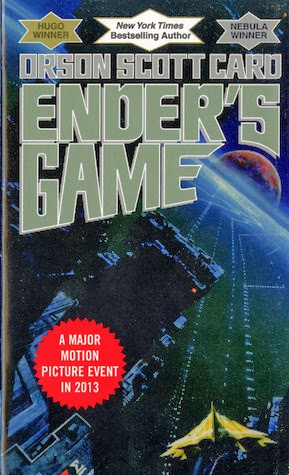
Ender’s Game (1985)
When Orson Scott Card wrote Ender’s Game, he created a classic for older children (“young adults”) and adults alike. When compared to most modern action/adventure stories (and movies) the pace of Ender’s Game strikes me as a bit slower. Even so, there’s plenty of action, suspense and drama as the reader follows young Andrew “Ender” Wiggin through his training the military Battle School in order to make the cut to continue to be groomed for eventual command.
The story is set far in the future, after Earth has recovered from an attack by a hostile species referred to as “the Buggers”; an attack that nearly annihilated humanity. In an attempt prepared for a future Bugger war, children are screened and selected for battle training in a special schoolhouse orbiting the Earth. The hope that some will show the right tactical and command skills, and have the overall mental capacity as they move into adulthood to make them qualified and capable of commanding a fleet of warships. This book focuses on young Ender’s training and testing as a child. Removed from his family at a very young age, his adventure is often less than pleasant and at times brutal.
Without spoiling the end, events take a dramatic turn late in the book, having a lasting effect on young Ender, and significantly shaping the rest of his life. This also sets the stage for the subsequent stories contained in what has become known as “Ender’s Saga.” This book, as well as those that follow, are full of all the good stuff that makes great science fiction--space, ships, a struggle to save Earth, and the hope we have in our youth to move us into the future. As with all great Science Fiction, Ender’s Game is thick with social commentary and leaves the reader chewing on weighty ethical questions once the story ends. This is great book for adults, and a wonderful tool for parents to share with their kids when the time is right. I believe the discussions over the lessons that apply to real life will last for years to come. Grab a copy and enjoy!
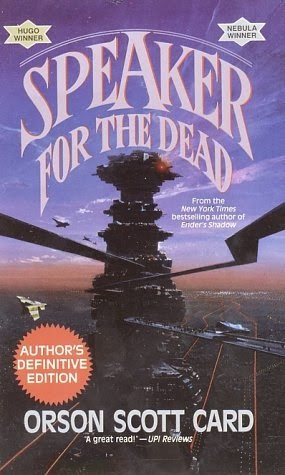
Speaker for the Dead (1986)
I loved Ender’s Game and was eager to finally read this sequel. Initially I wasn’t sure how the story would unfold but it took off quickly, building on the momentum created in the first book. According to Orson Scott Card, Speaker for the Dead was the story he originally set out to tell. Reinforcing what Mr. Card said, as good as Ender’s Game was, it only sets the stage for this story.
As with Ender’s Game, social commentary is at the heart of this amazing story, and the reader watches the practical results of the now mature thoughts and consequences of Andrew “Ender” Wiggin’s youthful act of xenocide committed against the Buggers. In an attempt to address, put into context, and perhaps even redeem himself from the savage act of xenocide, Andrew authors two books, “The Hive Queen” and “The Hegemon”, and becomes the first of a non-religious order referred to as Speakers for the Dead. Through these two books, and his words as a Speaker for the Dead, Andrew strives as an adult to limit (if not prevent) any future act of xenocide. Triggered by the practical calling for a Speaker for the Dead to address the death of several humans on the colony planet Lusitania, we watch a larger story unfold when the resultant moral doctrine contained in “The Hive Queen” and “The Hegemon” play out as decisions are made about how to practically deal with the much more significant emerging conflict between the Human and another sentient race called the Pequininos.
There are very few plot holes, but they’re not of consequence in the end. They’re easily overlooked and quickly overcome by this amazing story. If you liked the original story and haven’t read this sequel, please do. You won’t be disappointed.
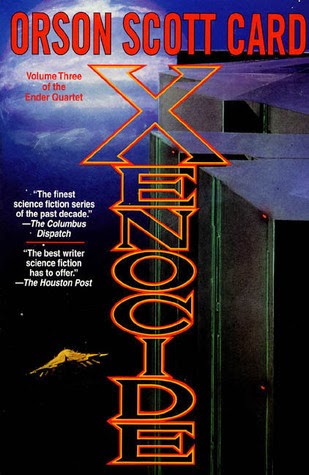
Xenocide (1991)
After the strength of Ender’s Game and Speaker for the Dead, I had to see where the story went and decided to read Xenocide even after hearing and reading very mixed reviews for the book. I’m glad I did. Xenocide took a slower pace than the previous books and deals with a human fleet sent by Starways Congress toward Lusitania. Onboard the fleet is a weapon called the Molecular Disruption Device (MDD, or the “Little Doctor”), a weapon with the ability to destroy an entire planet, sent with apparent intent to do just this to Lusitania. If so, the destruction of this colony world would result in the annihilation of all the human colonists as well as the xenocide of two entire races living only on Lusitania: the Pequininos and a third (surprise) sentient race. Working together, the three races struggle to find a way to stop the fleet and if necessary, to leave the planet.
Whereas moral and social commentary are usually undercurrents in science fiction, they take a much more significant role in this book as the author examines cultural, racial and even gender biases and preferences in the context of the struggle to preserve life: specifically what happens when the struggle for life and culture of one group puts another in jeopardy. Xenocide also examines the unique origins and life of Jane, Ender’s faithful companion and an apparently another sentient being (a third species outside of humanity) living within a communications network of devices called Ansibles, spanning the inhabited universe and allowing faster than light communications between the worlds.
This diminished the strength of the book for some, but I didn’t mind as the more traditional elements of science fiction were still solidly present: the possibility of a sentient life emerging from within the virtual world; an interesting and creative examination of a particle called the Philote; faster than light communication and travel; and time dilation. Some reviews I read expressed dislike for the liberties Mr. Card takes with science, however I enjoyed how he played with physics to enable a continuing and wonderful work of fiction. He’s no guiltier with his scientific liberties than most who preceded him in the genre.
While Xenocide wasn’t my favorite single book in the series, I definitely enjoyed it as a key part of a broader piece of wonderful storytelling. While taking a slightly different direction, Xenocide is a logical place and way for the story of Ender Wiggin and the universe he lives in to continue. Keeping that in mind, I recommend it to anyone who enjoyed Ender’s Game and Speaker for the Dead.

Children of the Mind (1996)
This book had many similarities to and differences from the first three in the Ender’s Saga. It’s very different from Ender’s Game and Speaker for the Dead in that it’s more philosophical, even though it’s much more a direct continuation of the primary story that left off at the end of Speaker for the Dead. While also different from Xenocide, there are a greater number of similarities with this book than with the first two. I mentioned in my review of Xenocide that social commentary takes a more significant role; in this book it takes a primary role. Children of the Mind is much more philosophical than the books that precede it but Orson Scott Card does a fine job of wrapping up the overall story of Ender Wiggin and those who surround him.
As Mr. Card continues and concludes the story of Ender, he takes the events of the previous three thousand years of history and uses them to pose the very difficult questions we often try to avoid: what is life, what does it mean to be human, what makes us individuals and is the value of an individual life when weighed against a greater population or even the entire species, and what is gender? His characters wrestle with the difference in value (if any) between life and sentient life. He also does a fantastic job of posing very significant and real moral questions on a societal level, and works through them (often without providing “the” answer): when should war occur; at what point does the price of employing a weapon of mass destruction outweigh the cost; etc.
My only constructive criticism or observation is about the title. I’m not sure what other name I’d give the book, but I didn’t feel the story was much about the order called The Children of the Mind. While they play a critical role in the story, the order itself is only a secondary actor. It seems the only real tie to the order is that the more heady and philosophical nature of this book suggests we’re all actually children of the mind in one way or another. Mr. Card challenges us to think about ourselves, humanity, and the world we live in.
I definitely enjoyed Children of the Mind. I recommend it to readers who enjoyed Xenocide, especially if you want to know how the story of Ender Wiggin concludes. My only “caution” to the reader is to remember the much more philosophical direction this book takes. Once again, enjoy!
I recently saw the movie Ender's Game and look forward to posting my review soon.
Based on my fondness for these first books, I'll continue reading in the Ender’s universe, moving on to the four “Shadow Saga” books. I also plan on reading Ender’s Game to my son soon.
It’s great to be a dad!


