Showing posts with label fitness. Show all posts

Wednesday, October 21, 2015

Learning From Failure

One of the challenges of parenting is finding ways to safely let your child fail at something so that they learn, grow and improve from it.  When you and your child are surrounded by like-minded friends, those inevitable moments of failure can become wonderful experiences.


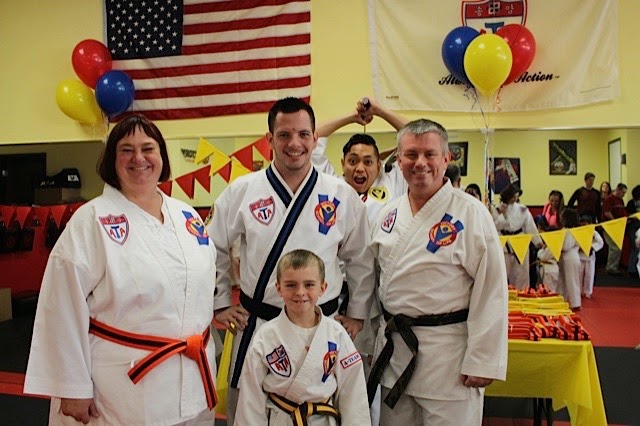
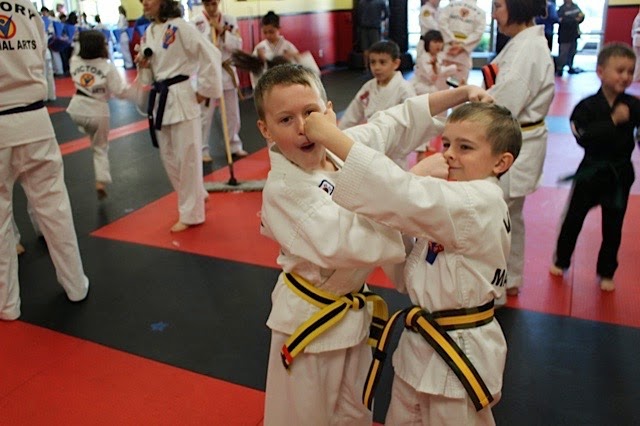
In April, all three of us tested for our next belts at our Victory Martial Arts school.  We each tested on different nights:  three nights and three tests, followed by a fourth night where we’d all stand together and tie on our new belts as a family.  Steph tested on Monday and passed, I tested Tuesday and passed, and our son tested on Wednesday.  He didn’t pass.  

He wasn’t alone, as several others failed as well.  Not to diminish what we were doing, testing this time was difficult for all of us.  Steph was working hard to gain and maintain the necessary skills while guarding against re-injuring her knee.  Training to pass her test while in the middle of physical therapy was a challenge.  Her perseverance showed though and she did fine in spite of some real difficulty and pain.  For Paul and I, this was our first training cycle and test as advanced students.  The standard required to be allowed to test is higher, and what’s required to pass the test is also more difficult.

At the end of the evening, our school’s director was fantastic with the kids who failed.  He took time to explain the role that failure plays in life.  It was a great teaching moment.  The kids who didn’t know how to learn from a failure had a glimpse within a very safe environment, how they could apply this experience and continue to grow toward success.  It was very special to see how the instructors and the parents came together to celebrate those who passed, and solidly encourage and support those who didn’t at the same time.  Let me be frank:  this is not a program that finds a reason for everyone to pass.  Everyone doesn’t get a new belt.  If you don’t meet the standard, you have the opportunity to train hard and try again next time.

What made this experience special was that while the kids who didn’t pass were still disappointed, they learned several important things:

First, they can and should be responsible for working to improve themselves for the next time, so they can try again.  Good instruction is provided, but as we know, that’s not all it takes.  Many of these kids knew as they were testing that they didn’t meet the standard to pass.  Some also felt that something outside of their control caused them to fail.  As adults and parents I trust we all know that this is how it is in life.  Sometimes you don’t prepare well enough.  Other times things happen that you don’t or can’t anticipate or control, and these things frustrate your best intentions and desires.  Even so, you can be the victim and blame everyone else, or you can work to overcome the obstacle.  Paul and so many others that night set out immediately to do better and not succumb to the temptation to blame someone or something else.  They strive to improve and perfect the things they can so that when the challenge comes, they’re best prepared to succeed…to win.

Second, there are journeys in life that are just as important as the intended goal at the end.  Running is one of those journeys.  The practice of martial arts is another.  Getting your next belt is always the goal.  Getting a black belt is certainly a goal that many view at THE goal, but working toward the black belt is where most of the learning happens.  Once you earn your black, there are additional degrees of progression.  The journey can end, but it can also continue beyond just earning a belt.  Even if you physically hit a point where the next belt is out of reach, the journey doesn’t have to stop.  The fit lifestyle and the challenges to maintain your health to the best of your ability can certainly continue.  Giving the benefit of your experiences, your wisdom, can (and should) continue as you help those who are at an earlier point in their journeys, or are struggling through something for the first time that you’ve dealt with many times before.  I believe the journey is really the adventure and the goal.  In the case of martial arts, the belts represent signposts or reminders from special points along the way.

Third, there’s still joy to be found in celebrating the successes of your friends and family.  Paul was clearly disappointed but he perked up quickly and continued to cheer for his friends.  At the end, he found as many friends as he could who passed and told them “good job”, gave high-fives and hugs.  As things calmed down though, some of his sadness returned and Steph and I had the pleasure to see him do something that many adults probably wouldn’t have.  He stepped outside with one of his best friends who also failed the test, sat on the curb, and these two amazing boys shed tears together as they comforted and encouraged one another.

What made this most special  for Steph and I was the Belting Ceremony.  Paul sat with us on the floor and participated as Steph and I tied our new belts on, even though he wasn’t receiving one himself.  He stood there with us, and each of us held an end and pulled together.  He told us several times he would never want to miss being there to celebrate with us and help us tie our belts on.  What a wonderful perspective coming from such a young man.

In the end, our son is learning how to deal with adversity and failure in a very safe and controlled environment.  With good instruction, support and encouragement from his family and friends, mixed with his own developing perseverance, he’ll continue down this path.  He’ll be a better martial artist for it.  I think as he applies what he’s learning to the rest of this life, he’ll be a better man.  By the way, watching him do things I’ve never did at his age makes me a better man too.  I’m so proud of my son!


That was in April.  Now it’s October.  We’ve tested twice since then, and next week is the next testing cycle.  So much has happened.  I’ll tell you the rest of the story in my next post.

 It’s great to be a dad!

Saturday, March 14, 2015

A Family Affair

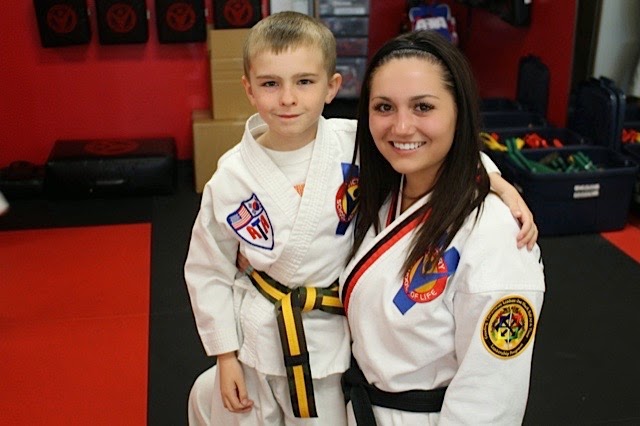
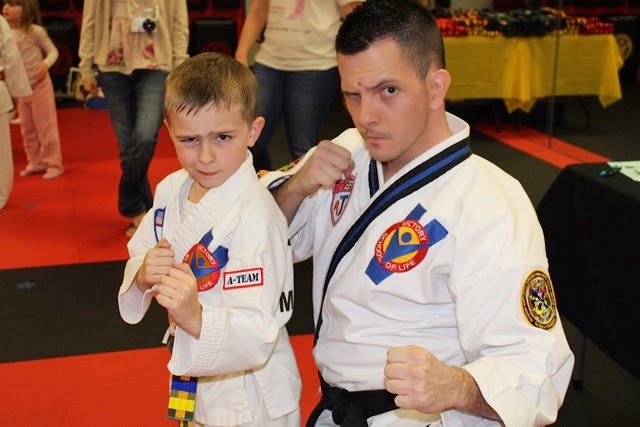
As many of you know, Paul has been taking Tae Kwon Do for eight months now, and I’ve been training with him for the last six months.  Two months ago, Steph also joined us, making the practice of martial arts a family affair for us. 


Steph’s commitment has been amazing, especially since the beginning of her journey hasn’t been easy.  With bad hips and a bad knee, she found herself unintentionally on the floor several times, but she maintained her “yes I can” attitude and continued to train with the support and expert advice of her physical therapist.  Two months after she began, all three of us went through testing last week to advance in rank.

I need to mention the instructors and staff at Victory Martial Arts - Summerlin.  Without them, this journey toward black belt wouldn’t be possible for Steph or I.  Our son is young and strong, and like most kids, he’ll try anything with a little encouragement.  His mind is sharp and his body is able.  Training is to do something new is always challenging, but his body adapts and grows stronger.  Steph and I “enjoy” all the challenges of middle age, along with a few additional permanent bumps and bruises that always try to assert themselves.  The instructors at Victory Summerlin willingly accommodate us, always adjusting the training to allow older bodies the chance to grow strong and more able.  Somehow they do this without making things easier or cutting things out that others are expected to do.  Then when testing comes, we find ourselves accepting the challenge to do the forms and break the boards just like the young men and women!  Mr. DeSmith, Mr. Guerrero, Mr. Scott, Mrs. Garretson and Miss Bivens:  you inspire us, you keep us motivated, you train us hard, and because of you, we succeed.


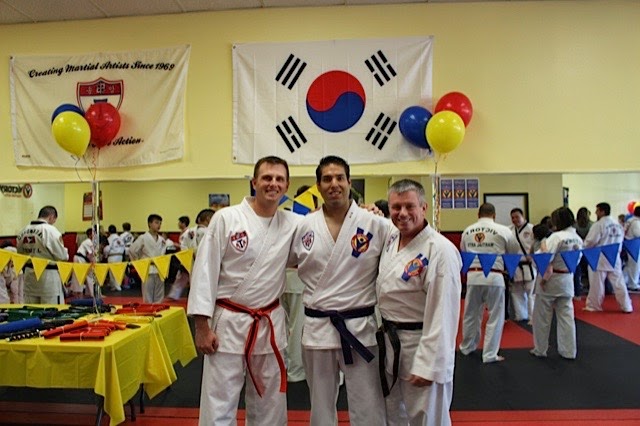
Our instructors are like family, but there are others in our Victory family too.  Paul has a wonderful circle of friends he trains with:  some ahead of him in the program, some at the same level, and some coming up behind him.  These young men and women are amazing, and it’s a pleasure to watch them all grow together.  He also goes to school and church with some of these kids, making this circle of friends a part of his whole life.  The same is true for Steph and I as we’ve become close with several of the parents, many of whom have also joined their kids on the training mat (and adding to the ranks of what several of us at Victory, with tongue in cheek, call the “Senior Division”).  We struggle and sweat together in training, encourage each other and our kids, and love it when we find ourselves doing things we weren’t sure we could.  Then we socialize and celebrate together.  There are too many to call out here, but we love each and every one of you!


So the recent testing week was special for us.  After all three of us successfully tested, we sat together as a family and were called up to receive our new belts.  Then we stood in a circle of three, with a hand on the ends of each other’s belts, and at the appropriate time, we all pulled and tied our new belts on together as a family.

The journey continues now as Steph works toward replacing her orange belt with yellow, and Paul and I do the same, hoping to replace our cammo belts with green.  Yes we can!


It’s great to be a dad!

Monday, January 19, 2015

Busy with Belts

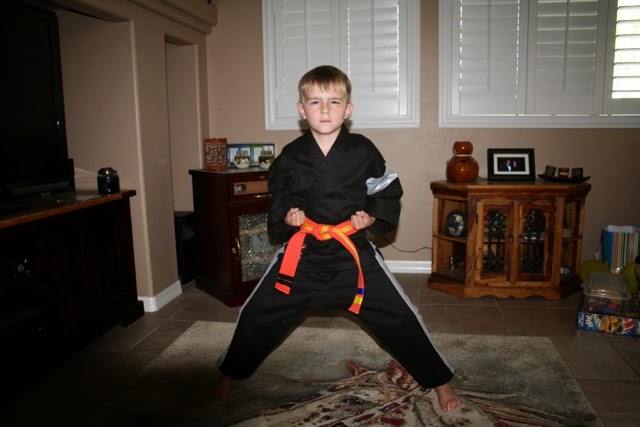
October through December were fun and full months for Paul and I!  Paul competed in his first tournament and both of us tested twice to advance to our next belts:  Paul went from orange to yellow and then cammo (recommended), and I went from white to orange, then to yellow.


The Las Vegas Inter-school Tournament

All four Victory Martial Arts schools in the Las Vegas valley came together for a city-wide tournament on October 18th.  With approximately 300 participants and four rings, it was a crowded blast!  Right after the tournament was announced, we asked Paul if he wanted to participate and with his nod of approval, we signed him up for two events:  traditional forms and traditional weapons, knowing these were two events he could perform well in, even if he was nervous.  The goal was for him to do something new, and build his confidence and self-esteem while having fun.  The morning of the tournament Paul went through an anticipated round of nerves, and we had to remind him we expected him to do what he committed to do.  Once he realized he wasn’t allowed to just back out, he began to relax.  Then after a few of his friends arrived, he shook off the nerves, found his confidence and was ready to compete.


Since this was his first tournament, everything about it was new.  Paul had to line up with the other beginner kids he was grouped to compete with (and without Steph and I).  This refueled a few nerves but by that point his enthusiasm and confidence was in control.  As his line walked in, they announced them and directed them to their ring.  Steph, her parents and I had seats at Paul’s ring and the competition began.


He performed his empty handed form as well as he’s ever done it, and made us proud. He did a great job entering and leaving the mat, and showed all the proper respect to the judges.  After completing his form, he sat and cheered for his friends, then prepared to do his traditional weapons form with the Jahng Bong (Bo Staff).  Even though it wasn’t the weapon he was currently training with, Paul chose to use it because he was already comfortable with the form and most other competitors would probably be using the current weapon (the baton-like Bahng Mahng Ee), allowing him to stand out a bit.  As it turned out, he was the only one in his group using the Jahng Bong and he stood out in a good way.

The first real surprise came when the first in his group was called up to perform with her weapon.  Like Paul, she was prepared to perform a trained set of moves (a traditional form).  When she was ready, the center judge told her, “you have 30 seconds…begin!”  She completed her form comfortably in 10-15 seconds and waited at the end for the next command from the judge, only to hear him say, “you still have 15 seconds…keep going!”  It was clear at this point that whatever the kids were going to do, they had to fill the time (or the remaining time) with a creative weapons performance.  It was a surprise for parents and kids alike, but  she didn't miss a beat and finished strong.  I looked at Paul to see if the change was going to trouble him, but he remained excited and confident—I honestly wasn’t sure if he didn’t realize there was a change, or was confident enough not to be bothered by it.  Steph and I had no idea what he would do once he took the mat.  He could perform his traditional form a couple times, traditional form once, then some creative moves, or just wing the whole thing and perform creatively for 30 second.  He did the latter and it looked like it was his plan all along, and his score for this was higher than his empty-handed form!


At this point, he was done with his events and could relax, continue to cheer for his friends and enjoy the rest of the day.  The next event that followed was board breaking and before we knew it, Paul was signaling us and silently mouthing, “I want to break boards!”  So much for the earlier nerves and a lack of confidence!  Since we didn’t register him for board breaking, he wasn’t able to perform, but I suspect he will during the next tournament!  Sometime about mid afternoon, we headed home and that evening he slept like a rock.


Belt Testing and Ceremonies

On October 21st I tested for the opportunity to move from white to orange.  It was an exciting time for me after training for two months.  As mentioned in an earlier post, resuming martial arts training after over 30 years is exciting and quite a challenge.  The mind remembers, but a 50 year old body doesn’t behave quite like the mind may want it to.  The training is challenging and fun and this is a deliberate first step in my own journey toward black belt—a chance to finish what I started so long ago.  I passed my test and what made it most special was having Steph and Paul there cheering me on, and Paul holding up a totally cool sign he made to motivate me.


Two days later it was Paul’s turn.  Steph, her parents and I were there to cheer him on.  With a sign we made for him, and a cowbell to make some noise, we watched our young man approach the challenge as a totally different guy than two months prior when he tested for his orange belt.  With several more months of training under his belt, being selected for the Leadership Program, and being bolstered by the experience of the tournament, he was completely confident.  (When he tested for orange belt, it was quite an effort to keep him calm and cut through his worry.)  He tested very well and passed without any issues.  We’re definitely proud that he’s continuing to advance and enjoy martial arts, but we’re most proud of him for the incredible amount of confidence he’s gained since he began.


The Belting Ceremony (Graduation) was fun and well done as always.  With the school decorated and students in clean, white uniforms, Paul and I were called up at the appropriate times to receive our belts.  Then family members were allowed to join the students on the floor to help remove the old belts and tie on the new.  Stephanie joined Paul and I and with our new belts loosely tied around our waists, Paul and I held one end of each other’s belts and Steph held the other two ends.  When the time came, we all pulled and tightened the new belts!  With the ceremony over, the celebration continued with food and music.

Then in December after another training period it came time to test again.  Paul worked hard toward his cammo belt and I did the same to advance to yellow and we both passed again!  Due to travel I was unable to test with the group I was supposed to , but consistent with our school’s emphasis on family, I was able to test with Paul the evening I returned from my trip.  It made an already special event even more special for the both of us.  Earning cammo, is significant for Paul as it moves him from beginner ranks to advanced.  At this point the learning, rigor and expectations increase for him individually as well as his involvement as a leadership student ratchets up as he starts helping the school’s instructors with the kids’ beginners class.  As for me, I continue to remind him I’m racing him to black belt!


Steph and I owe genuine thanks to our martial arts instructors, Mr. DeSmith, Mr. Guerrero and Mr. Daos.  These three men and our fantastic Program Directors (Mrs. Garretson along with Miss Bivins— both also black belts!) do a great job, as does the rest of the Victory Summerlin team of leadership students and black belts who are always there helping the beginners.  It’s a gift to be able to push kids and adults to their limits in a way that provides an important part of what they need for success in martial arts and in life, while keeping it fun at the same time.  As a footnote, we learned that Mr. Daos was selected to travel and perform with the Marvel Universe Live.  (Now we can say we know Spiderman!)  We’re sad to see him leave so soon, but in his place we gained another awesome instructor, Mr. Scott.  As a family we’ve all already benefitted from his expertise as he moved right in and started instructing as if he’d been there all along.


Steph and I look forward to watching our son continue to grow in the best of ways physically, mentally and emotionally.  Adding martial arts, and specifically the Victory Martial Arts’ program under the American Taekwondo Association, into his life alongside his academic education is truly preparing him for the years to come.  And speaking of Steph, she’s joined us in our journey and is training now as well.  We all test for our next belts in February: came (decided) for Paul, came for me, and orange for Steph.  Victory Martial Arts has truly become a family affair for us!


It’s great to be a dad!

Saturday, September 27, 2014

Victory Martial Arts - Leadership Program

Following up from my last post, Paul has taken another step in his development as a martial artist and in his growth as a young man.


Not long after Paul earned his Orange Belt, our Chief Instructor talked to Steph and I about placing him into the Victory Martial Arts leadership program based on the potential he shows in class.  Around that same time, there was a special demonstration and instructional event hosted by the Victory schools here in Las Vegas, featuring several senior black belts from Orlando, Florida (the home of Victory Martial Arts).  During that event, Paul also caught the eye of the visiting leaders and we consented to have them publicly invite him to enter the leadership program.


A week later, at our school, one of the Chief Instructors at our school announced in front of his friends that Paul had joined leadership.  He received a new belt representing his participation in the program (an Orange Belt with a gold stripe in place of the usual black stripe), and a new leadership uniform.  


Since then, he attends an additional 30 minute training session twice a week following the normal Beginner’s class.  It’s fantastic.  In these sessions he trails with the small group of other leadership students in a more difficult, but also more fun, class.  While the practical focus is on more advanced knowledge and discipline, more complex forms and additional weapons, the goal within the school is to develop these kids into martial arts leaders as they work toward black belt.  As Paul continues to advance in rank he’ll attend his usual training and leadership lessons, but he’ll also start help the instructors when they teach the beginners class.  He’ll directly apply what he’s learning as he helps other students.

The character traits taught and fostered through Victory Martial Arts are: Respect, Self Esteem, Communication, Discipline, Honesty and Belief. As important as these are in the practice of martial arts, it’s more significant that the knowledge and practical experience Victory provides for the kids is intended to directly translate into a positive attitude and a lifestyle of action in the child’s behavior and performance at home, in school and eventually in their jobs and all of life.  After only three months we already see these life skills carrying over into the Paul’s life at home and at school.  On a humorous note:  recently we were leaving a restaurant with Paul.  As we reached the door, he quickly turned back to face our server and the folks who work there and in a strong voice thanked them by proclaiming, “Goodbye Sir, Goodbye Ma’am!”, then stepped outside.  It was already habit to be courteous and show respect to those who had just helped (or in this case served) him.  Obviously this wasn't required ore expected but the habit carried outside the school.  We were amused and very proud at the same time.


This has been a great time striving toward a goal as father and son!  We’re less than a month away from testing again.  This time Paul will test for his Yellow Belt and I’ll test for my Orange.  And not too long from now, Steph is going to join us in the program too.  What an amazing addition to the things we do throughout the week to build and strengthen the bonds that tie us together as a family  through shared experiences, struggles, and striving together toward a goal.  In the process we’re also getting more fit, and we’re making some amazing new friends as a family!


It’s great to be a dad!

Monday, August 18, 2014

Our "Karate Kid"

Nine weeks ago my son began taking Taekwando lessons through an American Taekwando Association school called Victory Martial Arts—something he’s been asking to do for almost a year.  Steph and I kept putting it off simply because he’s been playing soccer for three years and at the end of each season he kept asking us to sign him up again.  At the end of last season, he told us he was tired of soccer and wanted to do something new, and asked to start martial arts instead of soccer.  So we signed him up!


As an athlete, I’ve been an “individual sports” kind of guy my whole life.  Maybe it’s fairer to say that I enjoy sports that I compete as an individual in.  Not that I’m not a team player or enjoy the community of team sports, but there’s something about how I’m wired that drew me to cross country running, and in High School, Kenpo karate.  While we encouraged Paul’s participation in soccer, there are all kinds of signs he’s wired the same way I am.  I wasn’t surprised when he grew tired of soccer and was even less surprised when he continued to ask to participate in martial arts.  (He also says he wants to run with me, but I haven’t convinced him to start yet.)

Steph and I are working the life-balance issues with Paul, just as all parents do with their kids.  We have a pretty stable routine that we believe best ensures he continues to do well in school (including getting his homework done in a disciplined manner), but not to squelch time during the week for him to participate in some form of physical activity (sports), and time to just play and fuel his imagination (LEGO, video games, etc.).  He knows school is always the priority, but we want him to have plenty of time to explore the other things that keep a life balanced/full/colorful.  In all these things, he has his circles of friends, and in most cases they overlap, creating a cool, common thread that connects all these major aspects of his life.

I’m pretty sure Paul doesn’t know just how thrilled I am that he’s involved in martial arts.  As I’ve watched him these past couple months, I’m remembering and reliving the thrill, challenges, pain, and excitement of learning and doing new things physically and seeing the tangible achievements (mental and physical focus, balance, confidence, etc.), especially represented by working hard and advancing to the next belt.  This past week, Paul tested for the first time and moved from White Belt to Orange Belt.  He was more nervous than I think I’ve seen him be about anything.  Steph and I worked through it with him as best we could.  Most of the time both of us were at every practice since he joined the school, and one of us was always there.  We were his champions, his encouragers, his cheerleaders when he practiced at home and during lessons.  As with so many things in life though, we can’t do this for him.  When testing time came, he had to take the test and perform the necessary elements in front of other White, Orange and Yellow Belts…and the Black Belts.  Yes, the Chief Instructor has the Black Belts test on the same evening as the junior belts.  The Black Belts were amazing examples for the young martial artists, and the advanced students also championed and cheered the new students as they took these first steps toward earning their own Black Belts.  Even with all the encouragement and practice, several of those testing to advance in the junior belts didn’t pass.  Some of the Black Belts didn’t pass either.  In this they became amazing examples to the lesser experienced athletes.  The parents were well represented at testing too—for the White Belts testing for the first time, all the way up to the Black Belts testing for the next degree!  It warmed my heart to see the amazing turnout by the parents and even other friends, many of whom brought signs and noise-makers to encourage the kids and adult students.


Paul worked through his nervousness and did amazing with his forms (with and without his weapon).  He struggled with board breaking though—the event we knew he was the most nervous about.  Along with several others, on his final attempt he broke his board and the crowd went wild, for Paul and every other athlete who tried so hard!


So, Paul has begun a new adventure in his life:  the practice of martial arts and the pursuit of a Black Belt.  But wait, there’s more.  As I mentioned, I participated in martial arts (over 30 years ago!).  This week I’m going to begin to train again, in a new style and with my son at the same school—Dad and Lad, racing each other toward a Black Belt.  And by racing I mean encouraging each other.  Paul’s excited about this, and so am I.  And since he’s a full training cycle and one belt ahead of me, I’m having fun pointing out that in this this thing we’re doing, he’s beating dad.  He’s already getting used to hearing me say, with a huge grin on my face and a high-five:  “don’t let me catch you, son!”


As always, it’s great to be a dad!

Tuesday, November 19, 2013

My First Marathon

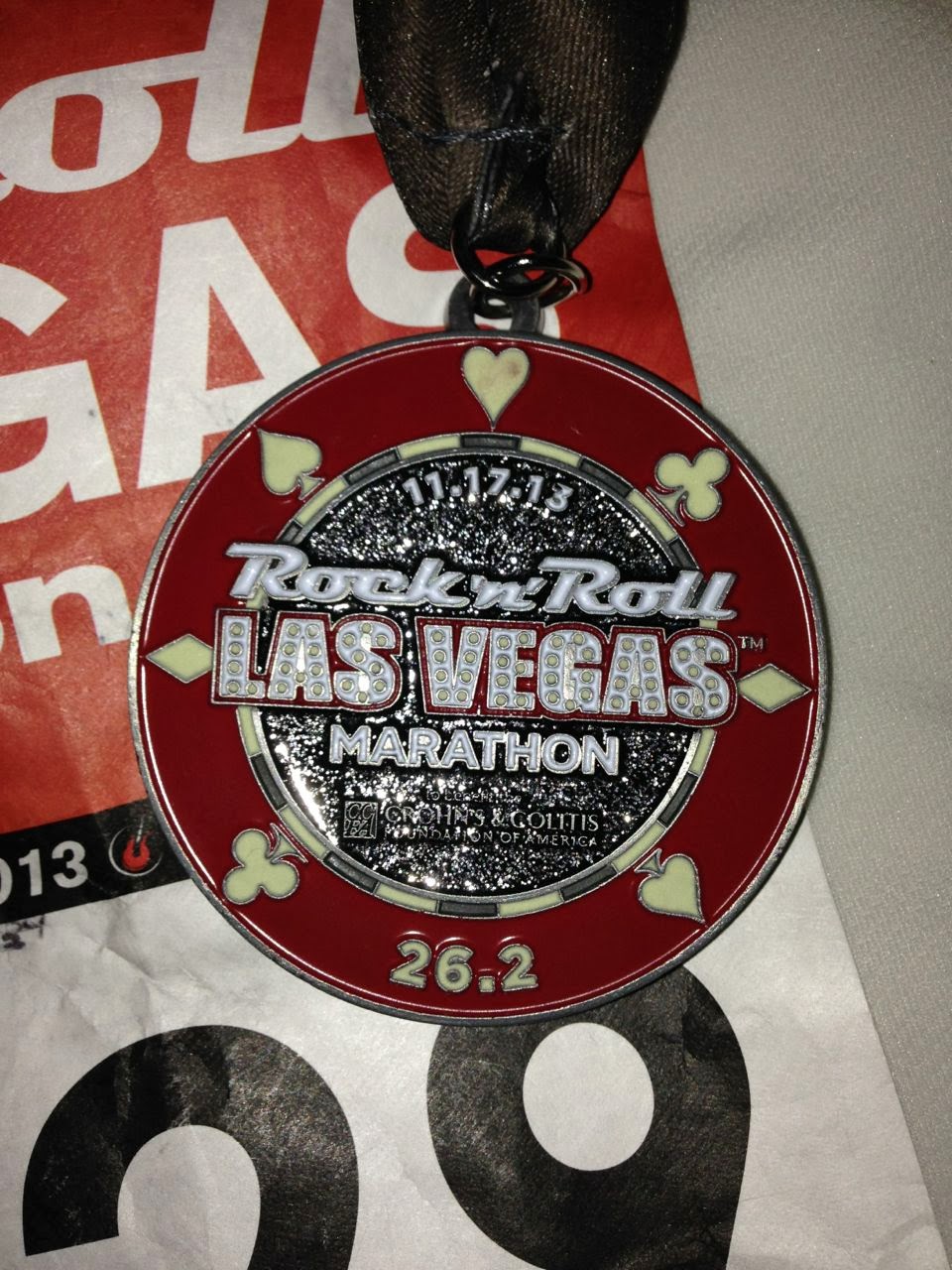
Two years ago I never thought I'd ever be able to run a marathon, but after putting several half marathons behind me and four months of dedicated training, I ran the Rock ‘n’ Roll Las Vegas Marathon!

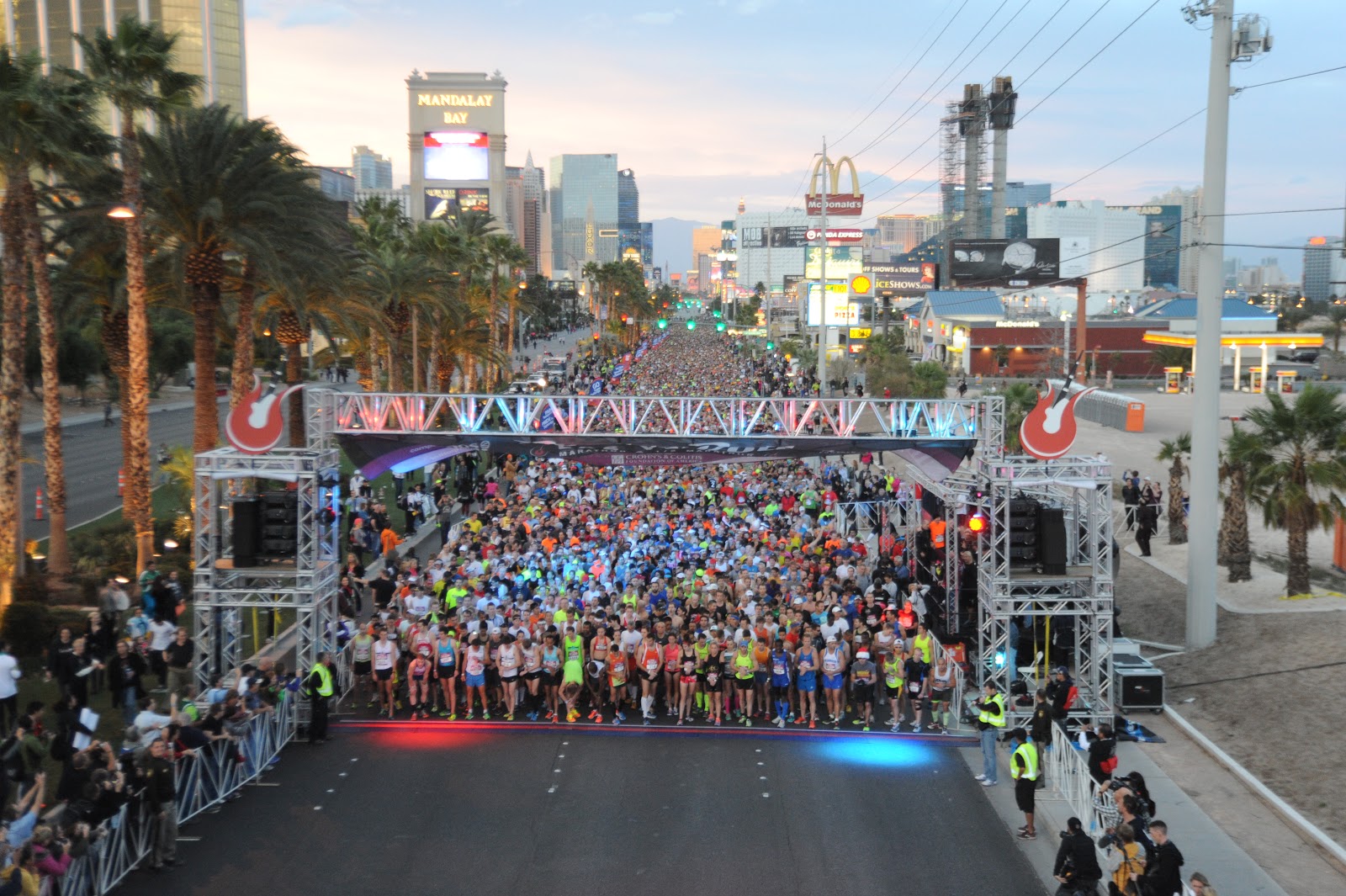
This is the same event that I ran my first half marathon during, just a year ago.  I completed the training without any issues and on the evening of November 17th I was ready to run, nervous and excited, and joined about 30,000 of my running buddies in the Starting Village as we put ourselves into a proper mental state with each other and with the help of the All American Rejects (who put on a fantastic concert for us!).  Then it was time to get into our corals, hear a wedding performed at the starting line (because it's what we do in Vegas) and the National Anthem.  Finally the gun sounded and we were off.  I set out to run the race in four hours and twenty minutes but ended up finishing in five hours and twenty six minutes.  I'll explain why.


I learned a few things through my training and the race.  First and foremost, a full marathon isn’t twice as hard as a half marathon.  It’s more than twice as hard.  I suspected this was the case when I realized I had passed through the 13.1 mile mark with what seemed like ease, but somewhere around mile 20 I was more than twice as sore as when I had finished the half marathons I'd run before, to include covering 13.1 to 20 miles seven of the last eight weekends during my training.  In the end, I think the marathon is the hardest thing I’ve ever put my body through.

Cramps.  Thankfully I’ve never had abdominal cramps or stomach issues while running.   I’ve had to manage leg and foot cramps after long runs at times but I’ve also never had to deal with them while running.  Until this race.  Between miles 17-18 my right calf cramped pretty hard.  It happened quickly and rather than pretend I could fight it, I slowed to a walk and let it resolve.  It seemed to take forever, but it worked.  I went back to running after it let go and continued on until sometime between mile 22 and 23 when it cramped again.  I slowed to a walk again.  It took longer to stop cramping but I finally picked up a slow running pace once it released.  At that point the front of my thighs were on the verge of cramping (probably the result of compensating for the misbehaving calf) but never did so, so I pressed on and crossed the finish line tired and happy, with a small group of other tired and happy runners.  The time I spent walking accounted for a good bit of the extra hour it took me to finish the race.

Hydration.  I don’t think the cramps were the result of dehydration.  I was well-hydrated, sweated throughout the race and even had to stop several times and take advantage of the portable bathrooms staged along the route.  I don’t believe I was over-hydrated either.  My watch and RoadID fit well and never got tight.  My hands and feet never swelled.

Nutrition.  I’d been training at longer distances with Gu gels and cut up nutrition bars, and if I ate during a training run, I’d carry water (rather than a sports drink).  I’d eat along the way every 45 minutes to an hour with good success.  On mid-length runs, I wouldn’t always take solid food or gels and would run with Nuun in my water bottle instead.  My longest runs made me sore but I never cramped.  With the leg cramps during this race, I have more experimenting to do with long distance nutrition.  I suspect the cramps were the result of not managing my electrolytes well and so an imbalance formed during the run.  (BTW, I’m a pretty salty sweater.)  Based on recommendations from others, I want to try Tailwind and will probably give it a go the next time I train for a long race.

Weather & Clothing.  The weather was perfect.  The temperature at the start was about 65F with low humidity typical of southern Nevada, and just a slight breeze.  Being a night race, the sun was setting as the race began and the temperature gently dropped throughout the run.  I wore shorts, a thin long-sleeved tech tee, with another short-sleeved tech tee on top.  Injinji socks and my Saucony Kinvara 3s on my feet, and no hat or gloves.  As is the norm, I had no foot problems at all (including no blisters).  I never felt too hot, and only got chilly when I was walking off the leg cramps.  BTW, the Kinvaras are now retired with that race bringing me just short of 400 miles on those shoes.  They were fantastic road shoes and I’ll probably replace them with a pair of Kinvara 4s.


My Family.  Training for this race took four months.  I couldn’t have done it without the support of my wife and son, who patiently dealt with my (very) early runs during the hot months, then my evening/night runs during my last month of training.  That last month was especially disruptive since runs were longer and often trampled over dinnertime and even my son’s bedtime on occasion.  And then there was the adjusted social schedule with friends and other family members.  I owe my wife and son HUGE thanks for letting me train for, and then run this race.  So thank you Stephanie and Paul!  I love you and I can’t repay you for your generosity and patience.

Now that this race is done, I plan on trying to work more variety into my training:  more general body strength, core strength, and I want to get back to working on the stairs and rowing again.  I’m also going to try to get back to more trail running.

So, will I do it again?  YES!  I definitely want to run another marathon.  The half marathon in Las Vegas is awesome because you spend all of the time on The Strip and parts of the Art District, but the added route for the full marathon is frankly boring, covering two long and straight roads.  I’ll probably continue to run the half marathon here but will look for my next full marathon in a different location: perhaps one of the southern California races in LA or San Diego.


It’s great to be a dad!


(Disclosure:  I was not asked to comment on or endorse, nor was I compensated for mentioning any of the brand products in this post.)

Monday, April 29, 2013

1000 Miles


Almost three years ago I began consistently logging my runs using the Nike+ website.  This month I passed 1000 miles.

I never set out with a goal to run a certain number of miles, so 1000 kind of snuck up on me.  Having run my whole life, I think I began logging my runs primarily to start keeping myself committed to run regularly, and maybe to see how much I was actually running.

Here’s how it breaks down:

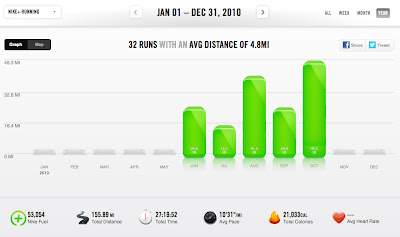
Jun-Dec 2010:  32 runs, average distance 4.8 miles, annual total 155.89 miles.


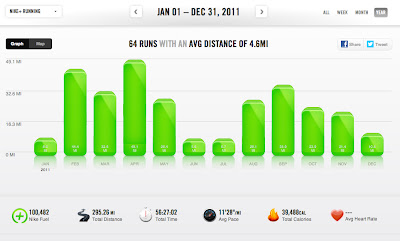
Jan-Dec 2011:  64 runs, average distance 4.6 miles, annual total 295.26 miles.


Based on the data I captured for seven months in 2010, I probably ran just short of 300 miles for the whole year, just as I did in 2011.  That tracks with my own perception of how I was running.  I was fairly consistent, with most of my running happening in the best weather during spring and fall.  This is obvious when looking at the graph for 2011.  In June of 2011, I moved from southern Germany to Las Vegas, Nevada: a dramatic climate change, but my running picked up again in the fall.

Jan-Dec 2012:  77 runs, average distance 4.7 miles, annual total 364.83 miles


Climate change aside, something odd happened in 2012:  my mileage was low in the winter, and stayed low through the spring and didn’t pick up until fall.  I’m not really sure why, since the weather is fine for running year round in Las Vegas, except for during the day in the summer.  It seemed I just skipped my usual volume of running in spring and I’m not sure why.  Back to why I started tracking my runs:  based on my own perception, I wouldn’t have noticed this.  The records gave me the ability to look back.  Regardless, what brought caused in increase in miles toward the end of the year was my decision to run a half marathon.  I grabbed a training plan from Runner’s World and started to work toward the goal of entering and finishing the Rock ‘n‘ Roll Las Vegas Half Marathon.  I ran that race in December 2012, ended the year strong and moved into 2013 pleased with what I had accomplished in the form of the half marathon.

Jan-Apr 2013:  42 runs, average distance 5.4 miles, annual total 228.77 miles. (Note: I had to repost this chart, which now runs through early October.)


I set a few goals for 2013:  to run at least two half marathons and to enter and run my first full marathon.  Little did I know that I’d almost immediately knock out one of the half marathons.  Late in December I received an email from Competitor prompting me to enter the Rock ‘n’ Roll Arizona event, pointing out that if I ran these two desert races back-to-back, I would pick up an additional finisher’s medal called the “Double Down”.  I entered and rolled right back into the last 30 days of training for a half marathon.  The new year was starting as strong as the previous year ended.

Now, four months into the year, I’m keeping my miles up better than in years prior.  As April comes to a close, I’ve logged just over 55 miles, pausing only for eye surgery at the very end of the month.  I’ll pick right back up again the second week in May, consistent with what the doctors advice.  I have my sights set on running the Rock ‘n’ Roll Las Vegas marathon in November this year, and somewhere between now and that race I’ll find at least one more half marathon to run to achieve my goals for the year.  Also, if the last two thirds of this year mirror the first third, I'm on pace to log just short of 1000 miles in 2013 alone.  We'll see how that works out, but I'd like to think I can do it with just a few extra miles here and there.

So what does it all mean?  There’s certainly satisfaction in seeing I’ve run 1000 miles.  I’m looking ahead, I'll cross the 2000 mile mark sometime around the beginning of 2014.  If the marathon this fall goes as well as I hope, I want to run at least one marathon in 2014 and attempt a 50K later in the year.  I’m convinced seeing my running progress charted out has helped me run like I should, rather than just thinking I’m running like I should.  I can see when I’m slacking off.  Even so, the charts alone don’t motivate me completely.  While I have a goal of running to maintain fitness (physical, mental and emotional), without specific goals to reach (races, time improvements), while still good it will quickly become less purposeful.  I think this is what happened during the first half of 2012.  Entering and running races ensured I have something specific I’m shooting rather than just the general/overall purpose of fitness.

Then there’s a long-term goal--perhaps THE long-term goal:  to run for the rest of my life and to be an example for my son.  I want us to enjoy each other’s company for a long time to come, and hopefully serve as a good example for him.  And you already know why.  Because...

It’s great to be a dad!

Saturday, April 13, 2013

Running Etiquette (Part 2)


My last post covered ten of my running etiquette “rules” and as promised, here are the rest.  I hope you find them useful!


Here we go, picking up at number 11:
  1. (#11)  The road or trail doesn’t care about you.  Potholes, rocks, lose gravel and the weather are indifferent about what you’re doing.  Wildlife doesn’t respect you or your good intentions either.  Don’t let the routine, the ordinary, or your experience lull you into a false sense of security.  Be prepared for the things that don’t usually bite you, literally and figuratively.  Hope for the best but have a reasonable plan for the worst.
  2. (#12)  Have a plan.  In the spirit of the previous rule, let folks know your plan and carry some form of identification.  Whenever possible I let my wife know where I intend to run and how far/long I expect to go. I’m also a huge fan of Road ID.  Let’s face it, we’ve all set out to run a certain route and/or distance, along the way you change the plan for any number of reasons and suddenly you’re not where you said you’d be.  Then you find yourself needing help.  Back to Road ID--pure figurative gold and very affordable.  No matter what, if someone finds you, they have the info they need to render aid and contact someone you’ve designated on your behalf.  If you’re an outdoor athlete, whether you run, walk, bike, ride horses, etc., get yourself a Road ID.  Hopefully the worst never happens, but if it does, make it easy for someone else to help you.  If Road ID isn’t your thing, that’s fine.  Just find a way to ensure others can find out who you are and render aid to you in the event you’re unable to ask for their help.
  3. (#13)  Hygiene matters.  If you’re an early morning runner it seems in most cases the shower understandably happens after the run.  Fine, but no matter what time of day you run, brush your teeth before you hit the pavement or trail, especially if you’re going to run with someone else.  We runners love our air and when we run we sure move a lot of it in and out of our lungs.  When you’re running with others, minty fresh (or even mediciny) breath always wins over last night’s egg salad or the kimchi you ate at lunch.  Trust me.  Your clothes matter too.  You might not notice or mind the clothes you’ve repeatedly run in for the last week, but your running buddy will.  Being frugal is one thing, but consider how often you probably ought to swap your shorts and tech tee for a fresh set.  Ditto for your body.  I didn’t forget what I said at the start of this rule, but knowing you’ll get a little “aromatic” when you log the next several miles isn’t a good reason to put off the shower that you probably already needed yesterday.  Last thing on this topic: if you run in Vibram Five Fingers, please throw those things in the washer every now and then.  Yes, you can do that!  They’ll hold up just fine and we won’t have to smell your feet even when you’re still 25 yards away.
  4. (#14)  Running is a journey.  I’m talking about a lifestyle or even a lifetime and of running, but just about every individual runs contain a little piece of that journey.  This one probably warrants a separate, dedicated post as well.  You hear runners talk about facets of this all the time when they say things like “listen to your body.”  When you run, you have time to strip away the usual daily grind at the office or at home.  It’s you, your body and your thoughts.  If you run regularly, you’ll inevitably find yourself noticing things about your body that you’ve never noticed before.  You’ll have the chance to work through issues mentally ranging from how your body is managing the physical stresses, pains and achievements of the run, to matters that the “normal” day doesn’t afford you the chance to dedicate thought to.  You can daydream, or listen to music or books.  You can actually enjoy an uninterrupted conversation with a friend who runs with you.  You’ll see the world around you differently.  You see things you’ve never noticed on the road you normally drive down.  The trail in the woods you never see other than to drive by becomes a beautiful adventure and a world all its own.  Over time all those runs add up and the time spent running makes you a better person:  physically and mentally.  Others may or may not notice, but you will.  That’s why I say running is therapy for the body and mind.
  5. (#15)  Run for fun!  I’m concluding by circling back to some of the thoughts in the earlier rules.  Don’t get all wrapped up in the gear.  Get yourself a good pair of shoes and get going--alone or with a friend.  Old shorts and a t-shirt are just fine.  Buy other stuff when and if you decide you need it.  Don’t let other people or someone else’s running attire become your excuse for not hitting the road or trail.  Generally speaking I don’t look like a runner, and quite often I don’t wear what some might consider the “right” clothes.  Whatever.  Enter races if you want, and if you do, have fun.  As Nike says, “just do it.”  Brookes says, “run happy.”  There are dozens of other appropriate slogans out there.  Pick one and take it to heart!
If you’re not a runner and this has encouraged you, let me know if you decide to get out there!  If we live near each other I’ll gladly run with you  If not, I’ll gladly be your virtual running buddy. 

As always, it’s great to be a dad!


DISCLOSURE:  Road ID did not ask me to review, support or recommend their product.  I don't have a relationship with them other than as a happy customer.  I've not been compensated in any way.  The opinion expressed here is completely my own.

Saturday, March 30, 2013

Running Etiquette (Part 1)


I’ve seen other runner’s etiquette and "rules" lists over the years and thought maybe I should share my thoughts with those who follow my adventures.  Hopefully you’ll identify with them, you might chuckle a bit, and I might even make you a little angry.  These are the “rules” I try to run by and they’re based on my own experiences dating back to my years as a young man when I started running with my Dad.  Some may be unique, but most are probably variations on common themes from across our sport.


  1. Never judge other runners.  You can certainly admire them, but don’t judge them.  They’re running too.  I think it was in Runner’s World I read, “there are no ugly runners.”  It captured the same attitude I’m trying to express.  Publications like Runner’s World (which is an awesome resource!) seems to present a picture of what some think is the typical (or stereotypical) runner: very lean, ideal form, and all the right gear.  There are many folks out there who look just like that, but if you see someone running who doesn’t fit the picture, remember this: at least they’re running.  You and I won’t ever know why or how most of the folks we see running actually ended up motivated to hit the road or trail--all you know is they’re there.  As a lifetime runner without they “typical” runner’s body type (I consider myself an “ordinary runner”), I’m pretty sure I’ll never look like those runners on the magazine covers.  The less-than-picture-perfect person you pass on the road or trail might have finally decided to give running a try.  They might even be on their very first run.  Or, they may have once been an incredible athlete, but are now recovering from injury.  What matters is they’re running.
  2. Acknowledge other runners.  A smile or wave of recognition or encouragement is always appreciated.  A kind verbal or non-verbal greeting goes a long way when shared with other non-runners on the road or trail too: walkers, equestrians, cyclists, etc.  Make a point to offer this kindness to others whether they return it or not.
  3. Your shoes matter most.  Other than shoes, all the rest of your gear falls into the “nice to have” category.  You risk hurting yourself without the right shoes.  If you’re just starting out and don’t know what you need, your best bet is to find a local running store.  They’ll assess you and let you know what kind of shoes you need.  Many of them will watch you run and/or look at an old pair of shoes to see how you move, then advise you from there.  Oh, and those shoes won’t last forever.  Understand that if you get into this, you’re probably going to buy new running shoes every 300-400 miles.  Distances vary depending on whose advice you’re considering and how you run.  Regardless of miles, if your feet, ankles and knees start complaining and there’s no other cause, it’s probably time to treat yourself to some new shoes.
  4. Running is an individual and a group activity.  For many of the runners I know, it’s primarily individual rather than social.  However, you’ll still find like-minded buddies to share your passion with whether you run with them or not.  Fact is, there’s an individual and a social element to running no matter who you are.  Even if you’re a solo runner, find a local running group or track club, or even a casual group of friends at work or school who also run.  I’m pretty sure you won’t regret it.
  5. Running buddies and training plans keep you focused.  I mostly run alone unless I’m in a race, but I have several running and non-running friends who expect to hear about my jaunts.  They ask regularly and my answer can’t be, “I didn’t run.”  They’ll apply all the appropriate pressure.  Call it accountability or something else, but it’s nice to have others around you who are interested in what you’re up to.  For those solo runners like me, training plans give some structure to the routine.  Even if you enjoy running, you’ll find yourself in those periods of slump when the routine becomes too routine or you’re not challenging yourself.  Having a race goal and following a related training plan causes you to add variables you might not otherwise include:  flats and hills, slow and fast speeds, changing distances, etc.
  6. Running is competitive.  Here’s the secret though: you may not always (or even usually) compete against another athlete.  Your primary competitor may be a new distance or a personal best/record, a change in the frequency of your running or weekly volume, or a change in the time of day you run.  There may or may not be another human there.  This is true for races too.  I know I care very little about when other runners finish the race I’m in.  The competition for me is to finish what I started and how that finish compares to any previous races of the same kind.  But if you’re competitive and want to race others, you’re still in the right place!
  7. It’s as much a mental game as a physical one.  Maybe it's more mental than physical.  No doubt running is a physical activity and it carries all the physical benefits and consequences with it.  Learning to physically deal with discomfort and pain is only a part of it though.  Right along side the physical aspects are the mental and emotional ups and downs associated with your commitment to run:  mentally dealing with the physical discomfort, pain and injury; nerves on race day; and frankly moments of boredom.  Whether you run with some form of audio entertainment or not, running is not always the most mentally stimulating task.  I’ve mentioned it before: running for me is mentally therapeutic.  Even so, running with music, an audio book, or just my thoughts along with the urban or natural sounds that surround me can still result in those moments where my brain wants something more or different.  Discipline is called for: yes physically, but also mentally.  Oh, just getting out the door to run may be the thing that requires the most mental discipline.
  8. Never defend your right of way.  The rules of the road or trail are nice, but your soft body will usually never win a contest with a bike, horse, or motor vehicle.  At best, you’ll probably break even with another runner or jogging stroller.  Courtesy and respect are always nice when they’re extended to you, but in the interest of safety and deference to others who may not even see you, when in doubt, err on the side of caution and respect the things around you that could cause you harm.
  9. Respect the distance.  This rule, and the next probably warrant their own dedicated posts:  No matter whether you set out to run a mile, a 5K, 10K, half marathon, marathon or ultra, patiently and properly train for and respect the distance.  It’s the best way to avoid injury.  Biting off more than you can chew after a moment of sudden inspiration usually ends in unnecessary pain and discouragement.  I know this will anger some, but I also tend to think unless a race clearly advertises otherwise, running races are for running and the achievement of crossing the finish line is diminished if you treat it otherwise.  If you enter a race knowing you can’t or won’t run through to the finish, consider covering the distance outside of the timed race setting.  This is especially true of the longer distances: the half marathon and longer.  I’m definitely not the fastest runner, but I’ve never entered a running race without the expectation I’ll run from the start to the finish line.  You can (and should) do the same!
  10. Walking is awesome.  This is related to respecting the previous rule.  Do what you can do to gain and maintain good health.  There are times when anyone who runs finds they need to walk during training and during a race: to repair equipment, perhaps to eat or drink (I can’t drink from a cup without walking), to deal with an injury or help a fellow runner.  When you need to slow to a walk during a race, check beside and behind you then move to the side of the course.  In other words, run like you drive--or should I say run like you’re supposed to drive.  Some races declare a side of the road or trail for slower runners or walkers.  If so, follow the rule.  When it’s all said and done though, if you move to the side, you’ll lessen the risk of surprising or angering a runner behind you who may want to pass.  You’ll also reduce the risk of causing a wreck and getting hurt, or hurting someone else.  If you’re a runner, pay attention to the races you enter.  If the race allows walkers, parents with strollers, etc., don’t get mad when they’re there and moving slowly along the course.  Walking is awesome too, but enter running races to run unless the race specifically accommodates walkers. 
I’ve probably amused, intrigued and angered enough folks at this point, so I’ll stop for now.  In a few weeks I’ll post the rest of my thoughts on running etiquette.  In the meantime, if you happen to see me out there, let me know if I don’t smile and wave.  And please don’t hit me with your car.

It’s great to be a dad!

Saturday, March 2, 2013

Is Running Too Expensive?


I recently posted in a running community on Google+  “Running is about you and a pair of shoes.  Okay, and a shirt and shorts unless you want the cops involved.  But many in our sport are also geeks and end up pushing ourselves harder and further.  We want to know more about the how, why and what's happening to our bodies when we run.  We want to adjust and tweak.”


While someone just trying out the sport may watch others of us geek out, remember you don't need all the sporty gear and tech to get the job done.  You don't have to look good, be color-coordinated and sport all the latest gear.  I've said this before and really meant it: running is a form of playing.  Just watch kids; they just run.  They don’t geek out about gels, don’t wear fancy hydration belts or sport GPS watches and heart rate monitors.  Even though it’s fun to geek out with all the latest goodies, we can do just what the kids do, and it’s okay.  You, a pair of shoes, and clothing adequate for the climate:  that’s all you need, especially if you’re just starting out.

Shoes.  You don’t even have to get overly stressed about all the varieties of shoes out there.  Find a friend who runs and head to a running store.  Tell them you’re starting out, and you want an appropriate pair of shoes to give this running thing a go without breaking the bank.  Or, unless you have issues with your feet, hit a major chain sports store or even the shoe section in a department store.  Try on a variety of shoes and buy a pair that feels good on your feet and fits well.  You probably won’t go wrong with a recognized brand that makes running shoes, but don’t feel like you have to succumb to the marketing machine either.  Many of the big brands have a variety of shoes including several models a reasonable price.  Just remember, how your new shoes fit is important.  How they look is not.

Socks.  As a new runner, if you’re going to buy anything else other than shoes, buy yourself a few pairs of running socks.  Again, easy to geek out and find all sorts of custom running socks out there, and they all have a place in the sport.  Don’t spend the money to buy those just to find out you don’t like the whole running thing.  If you don’t already have something that’ll work at home, grab a few pairs of ankle-high athletic socks.  They’ll work just fine and keep you from looking like your grandfather when you wear those over-the-calf white, high school athletic socks with your shorts.  (I said you don’t have to look good, but you also don’t want to scare folks either.  (This is why I don’t run shirtless.  I don’t think I look very good without a shirt and I really don’t want to scare small children or cause passing cars to crash at the terrible sight of my pasty bod.)

Running Clothes.  Clothing is easy because new runners run short distances.  Somewhere in your stuff is a cheap pair of athletic shorts or sweats and a t-shirt.  They’ll  work just fine.  Go with long sleeves or throw on a wind-breaker if it’s chilly.  Don’t worry that all your friends who are veteran runners have those technical shirts that wick water away, keep you warm (or cool), and are rumored to deflect rogue cyclists and cars along with rain and snow.  Those shirts are great (and I own a bunch of them!), but I promise you can trot around the block or cover a few miles in those old shorts and tees.  Also, if you work your way up to entering and running 5K (3.1 mile) races, find the ones that offer a shirt.  They’re usually the technical tees and you’ll quickly end up with a drawer full of them.  Bottom line:  don’t pay the money to outfit yourself for a marathon when you’re just exploring those early, short distances.

Running Buddies.  Finally, find a buddy to encourage your running and not your fashion sense.  Related, runners are like anyone else and come in two basic varieties: demanding and encouraging.  The demanding ones will want to drag you “up” to their level immediately and make you another version of themselves.  They’ll try to drag you along (and probably suck the fun out of the experience).  You’ll be equipped to run a marathon before you’ve even decided if you like running a couple miles, and you’ll feel guilty you’re “not dedicated enough, wearing the right gear, or doing more or better.  They may be great friends, but they’re probably not the best running buddies.  They need to run with someone who is at their level, not with you.  You’ll also know a person or two who is happy to work with you to explore the sport just as you are: someone with the heart and mindset of a mentor or coach.  They’ll encourage you rather than drag you.  They’ll answer your questions and help you along the way.  Most importantly, they’ll allow you to become the runner you are, not a carbon copy of themselves.  If you’re a social person and already know you’ll be a social runner too, or you’ll need the encouragement, find that encouraging person and team up.

This advice has grown out of my lifetime of running.  I’ve mentioned before that my son will start running with me this Spring, not because I asked him to, but because he asked to run with me.  I assure you he won’t look like “Mini Me” when we start down the path.  He’ll look a whole lot like a kid who just ran off the playground than he does a little runner in all the technical regalia.


Now get out there and run like you mean it!

It’s great to be a dad!