Showing posts with label development. Show all posts

Wednesday, January 22, 2014

Realizing Your Mortality

Readers:  this post covers a heavier issue than usual.  I hope it’s useful to you now or at some point regarding how you may address the issue of mortality with your kid(s) or young people that you might have the opportunity to mentor.  

Early this month my son woke up crying in the middle of the night.  When Steph and I went to his room, he said he dreamt he was “buried in the ground under dirt before it was his time to die.”  He went on to say through his tears, “I don’t want to grow up and die.”  It’s important here to point out this wasn’t a horror movie kind of dream.  He wasn’t buried alive or anything like that.  He said he saw himself as if he was buried after he had died and clearly knew what had happened.


My son turns seven in February.  When I was a child, not much older than he is now, I also became aware of my own mortality.  I can’t recall anything in particular that could have triggered this realization, but I remember there were two related things that struck me heavily at that point in my young life.

First, I realized I was growing older, and as that continued, I would lose interest in the things that I liked to play with and do as a child.  It was obvious to me because I never saw any adults (my parents included) playing with anything I liked to play with or frankly doing anything I thought was fun at that young age.  That made me sad because from my young perspective I had some cool stuff and did some pretty fun things!  Everything about life was an adventure and I never wanted it to end.  But I could see movement toward a time when I wouldn’t enjoy these things.

I think the second revelation was a result of the first. I realized someday I would grow old enough that life as I understood it would end:  I would die.  I think it’s important to say I don’t remember knowing anyone who had died, or even being aware of anyone actually dying, but the simple logic of my young mind allowed me to put the pieces together.  This had a real impact on my life for several years to follow, as I wrestled with what it all meant.  Honestly, outwardly I was a regular kid, but inside I was distracted by my own mortality.

I don’t talk about it often in this blog, but it’s not something I hide either: I’m a Christian and as a result, I hold to the hope hope that when life in this body ends, I don’t simply cease to exist.  I wasn’t brought up this way though, nor did I experience anything akin to a conversion at that young age when I wrestled with the concept of death.  I mention this because as a child in what was practically an unchurched family, my parents didn’t have anything to offer me in the form of an explanation or context—not from a Christian point of view, or any other.  Life was just life.  Apparently you live, and then you die.  End of story.  

I remember at the point the frailty of life gelled in my mind, I was sick with a cold—a cold and nothing more.  But I was sick and as a result, a bit miserable.  In the middle of the night (like my son), and not directly related to being sick, I became aware enough of mortality that I sought the comfort of my parents.  I went into their room and as they comforted me I expressed to them my realization that I would die someday.  Looking back it was a bit of a funny moment, but when I told my mom I knew I was going to die and that it was disturbing me, she responded in an attempt to comfort me by saying, “you’re okay, you’re not going to die, you only have a cold.”  She didn’t understand that I wasn’t talking about having a cold, nor was I worried I’d die from it.  I can’t be critical.  What parent comforting a young child with a cold would ever think the issue at hand was actually the realization that death is a part of life.  I didn’t try to explain my struggle any further, they ultimately calmed me down, and sleep visited me again thanks to a soft back rub and the tiredness associated with the middle of the night.

Thoughts of the reality of my own mortality burdened me though for several years to follow, stealing some of the enjoyment from many of the things that were a part of my life.  It was a nagging preoccupation.  That brings me back to my son.  I remember struggling with the same thing and have worked to encourage his concerns by offering hope that there’s more to life than just life in the bodies he sees.

My son’s struggle with this issue does differ from mine in an important way :  he’s definitely aware of two deaths.  I blogged about losing my dad in August 2012.  My son was old enough to be very aware of what was happening as we visited my dad when he passed away, then during the memorial service in the days to follow, and finally when we interred him at Arlington National Cemetery a few months later in December.  Much less significant, but every bit as much real, we had to put our cat down just before we traveled to Arlington.  My son loved the cat and I’m sure he’ll always consider him his first pet.  

Although these things happened over a year ago, Paul has continued to talk about it regularly.  Not in a bad way, but it’s clear he’s continued to wrestle with mortality, and it seemed to come together in some way when he had his dream.  Since then I’ve worked to encourage him based on my own beliefs, and he seems to be handling it well.  One of the recurring discussions we have when he makes me aware he’s thinking about these things is that while we believe life goes on after our bodies die, it’s okay to be sad when we lose someone here.  It’s okay that we’re sad because we can’t see them like we used to any longer.  It’s also okay that we remember those we love who have preceded us in death.  And as a Christian, we can take comfort in the hope we’ll see our loved ones and friends again some day.  For those reading this who hold an orthodox or reformed Christian view, I’m sure you’re wondering how I’m dealing with the teaching that in death, everyone doesn’t go to Heaven.  I’m doing my best to be careful not to say (or imply) that everyone goes, but I’m also being careful not to lead my son down the path where I shatter any hope.  He’s not ready to have that larger and much more heady discussion just yet.  For now and for him:  all the hope I can offer a child with the stage set for the deeper discussion later.

We often hear the word “closure” associated with the passing of a loved one.  A year later, with all the understanding I can muster after losing dad, I think I’m mostly there.  Not completely, but mostly.  A way I describe where I am in the healing process: the open wound is closed and a scar is forming, but it’s still very tender.  Some days I think my son is farther along than I am; other days I’m convinced he’s not.  I do my best to understand all of this from his young perspective, not to make too much or too little of it all, keep it in perspective, and just be his loving (and living) dad.  My own childhood struggle with the matter of mortality certainly helps me with this.  I know this though:  it’s a privilege to be my son’s dad, and to be by his side as he continues to wrestle with it all.  There aren’t words to explain how special it is to be the man he turns to for explanation and comfort, to share what he’s thinking, and to cry and laugh with about anything and everything.  I get to watch him grow!


It’s great to be a dad!

Sunday, March 6, 2011

It's Wake-up Time!

Paul has a digital clock in his room.  He can’t really tell time but knows his numbers, and knows he’s not supposed to wake us up before the first number is seven; any smaller first number and he can play quietly in his room; any number bigger than seven and it’s okay to come out.

During the week his past week, I was already gone for work and sometime around 6:40 a.m. Paul calls out to Steph, “it’s wake-up time!”  She glanced at the clock in our room, told him it wasn’t and to go back to sleep or play quietly.  A few rounds of “yes it is, no it isn’t” ensued before Steph finally told him, “if I come in there and the first number isn’t seven, I’m going to be angry with you.”  Paul all but challenged her to come and see.  She got up and headed in.
Paul is four and I suppose some of you are already thinking Steph will walk in and discover he had somehow changed the clock.  While it’s possible, this isn’t what was going on.  She walked into his room, looked at the clock and saw it was displaying the right time, still a bit before seven.  She pointed at the clock and told Paul, “son, look at your clock.  It’s not seven yet.”  Paul’s response?  With absolute sincerity, he pointed at the same clock and said, “Yes it is Mom, but look.  The six is pretending to be a seven.”
This same week on two other occasions, both after the “six pretending to be a seven” incident, he was up early and told us it was time to get up because the sun was already awake.  Over the years I’ve become a morning person, so this doesn’t bother me; I’m usually up and going before Paul, regardless of the day of the week.  (As I write this, I wonder how and when I hit the point in my life when “sleeping in” means sleeping until six in the morning...)  Anyway, I’m usually up.  But Steph’s definitely not a morning person, so during the week anything earlier than seven is getting up early for her.  The days I don’t work are the days she can truly sleep in and I get to start the day with some quality dad-and-lad time.
The day will come soon when Paul will change the clock and think he’s done something sneaky.  I also know we’re not too far from allowing him to come out of his room even before we’re up, as long as he plays quietly.  Until then, I’m proud to see his young imagination racing along.  The six is pretending to be a seven now, and being creative enough one day to change the clock--that’s my amazing, awesome son!  As I said, and as I tell him every night I have the privilege of putting him to bed, I’m proud he’s my son and I’m proud to be his father.
It’s great to be a dad!

Saturday, February 19, 2011

Get The Wax Out Of Your Ears

Like all healthy kids, my son has made the transition from infant to toddler, and now to four year old child.  No more toddling.  Now it’s all about racing, running, crashing.  Everything is fast, furious and exciting, only punctuated by a wipe-out, or a nap when he literally runs out of energy and makes a rapid transition from active to sleeping.  It usually takes about a minute once he gives in.

Along with those changes comes wax in the ears.  As the oldest child in my family, I remember hearing my parents routinely tell my sisters to “get the wax out of their ears.”  More and more often I hear myself saying similar things to my son, especially when I have to stop him from whatever he’s doing and make him look at me as I say, “listen to me.”  It seems about half the time I tell him this, it’s to stop him from doing something I know will lead to injury.  I may not be the smartest guy around, but the wisdom of 47 years definitely trumps the zeal of four.
My son, again like all kids, gets the wax out, acknowledges what I said, and the all too often lets what I told him go in one ear and out the other--something else I remember hearing my parents say to my sisters and I.  As all parents know, this comes with some measure of frustration as you strive to strike the balance between the strictest of enforcement and prudent liberty that follows the warning.  
One of those acute moments of frustration happened the other evening.  My son was all spun up and bed time was approaching.  (By the way, I’m convinced “spun up” is a statement of middle-aged denial.  It’s how we gently admit that we don’t have the strength or energy we used to have, especially when it’s obvious as we watch our kids.)  I marshaled him into the bathroom to brush his teeth.  The blur of motion and energy continued as he climbed onto the small stool in front of the sink.  Then came the series of warnings:  stand still or you’re going to fall off the stool and hurt yourself.  Are you listening to me?  Stand still.  He responded with an “okay”, then continued to dance around.  Mere seconds later one foot comes off the stool and Paul hits the side of the sink with his cheek as he unintentionally took an eight inch step down.  Ouch.  For Paul there was a stunned moment, then tears fueled by pain.  And for me, frustration.  I was torn between two simultaneous desires.  I wanted to hold and comfort him, and ensure he was okay (which I did).  I was also angry and wanted to scold him for doing the very thing I just told him not to do, for the reason he was now crying--injury and pain.  (Which I also did after I was sure he wasn’t injured badly.)  In those moments, I reminded myself that my job was to lovingly comfort and teach my son, and to reinforce what he chose to dismiss.  Even though I was frustrated, it wasn’t lost on me that to a great extent this specific instance of the problem was self-correcting.  I warned him he could get hurt and told him how to prevent it.  He listened and applied that guidance with all the wisdom of a four year old and chose to dismiss what I said.  His close encounter just seconds later with the sink and the resulting sore cheek made it clear what the consequence of not listening were.  And although I was angry, I had the awesome role of holding and lovingly correcting my awesome son.
I would never wish pain on anyone, especially a child, but this life comes with pain.  I think we need it for a variety of reasons.  At times it provides contrast to pleasure and ends up enriching the good things we enjoy.  At other times it reinforces the cost of unwise action.  Even then though, I hope when pain comes, at worst it’s only a shadow and caution for the wounded of the worst things that could happen.  One of my favorite authors, C.S. Lewis, wrote that “pain is God’s megaphone.”  I think he was right.  And at times like this one in the bathroom, although undesired, it clearly serves as dad’s megaphone.  I never had to raise my voice; my son understood (at least for a little while) my caution to him was out of love.
The rules are the rules, parents must be obeyed, but some things just have to be learned through experience.  Authority matters, but learning comes through words and deeds.  The real world exists in the middle and in the fine tradition of parenting, we strive to set rules in a loving environment that are reasonable and enforceable.  Paul needs to learn when we tell him something, we mean what we say.  But we also need to let him grow through experience, often associated with the risks of scraped knees, bumps and bruises.  Apparently this is especially true with boys.  This frustration, and at times the associated fear...it’s real, but I wouldn’t trade it for the world!
It’s great to be a dad!

Tuesday, October 19, 2010

Imagination

One of the things I love most about being a dad so far is watching my son’s imagination develop.  I try to encourage it.  The results at times have sprung out of the blue when some crazy, cool new demonstration of imagination just appears.  The other night Steph and I were eating pizza for dinner and decided to sit in the living room instead of at the table to catch a show we rarely get to see.  Suddenly Paul starts humming music from the Star Wars movie “Return of the Jedi.”  The tune was from the scene when the Imperial Dreadnought “Executor,” crippled by a rebel Y-Wing, crashes into the unfinished second Death Star.  We looked up and his slice of pizza had become the Dreadnought and his plate was the Death Star.  But this wasn’t our imagination interpreting what he was doing; we asked him and he told us, “it’s crashing into the Death Star!”  Thankfully the camera was handy.

Steph and I clearly started and continue to encourage his fondness of Star Wars (and all things SciFi), but this was the first time we saw him apply is imagination in this way.
Traditional Blocks
A year or so ago we also bought Paul a basic set of building blocks.  You know the ones: a simple variety of colors and basic shapes: cubes, rectangles, wedges, cylinders, and planks.  Usually small buildings or garages emerge so he can drive his toy cars and trucks around them.  Then one day he built a tower--one that we didn’t have to pretend looked like one.  Paul even took a couple toy men and put them on and around it.  They were mediaeval knights standing guard to defend the tower from attack.  It was a good, strong tower, built on the stone cliffs of...the coffee table.  Of course, no tower is complete without a dragon, and as you can see Paul was happy to play the role.

The tower withstood relentless attacks for what must have been an appropriately long time in Paul’s mind, and then its walls fell.  I suspect the cool thing for any boy who gets to be the dragon is that he gets to destroy the tower when his imagination drives him on to another adventure.  Certainly that’s better and much more fun than the alternative--Steph or I getting tired of having it in the middle of everything and putting it away for him.
LEGOs
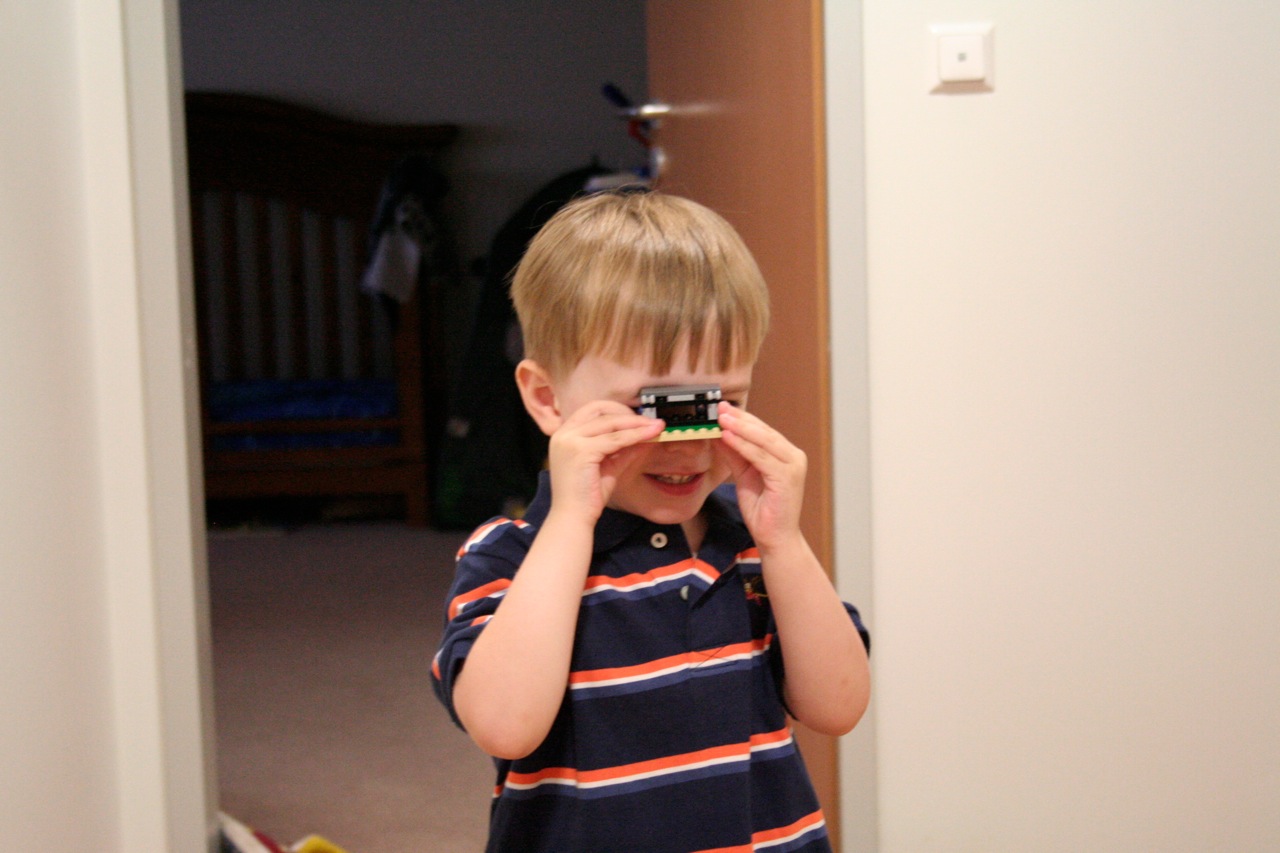
Paul has a growing collection of LEGOs; a childhood staple for kids since prehistoric times.  His consist of an assortment of basic building blocks, and some of the Star Wars kits (of course).  While the Star Wars kits don’t usually lend themselves to a lot of creative building at this point, he’s always playing out scenes from the movies as well as new scenes from his own imagination.  Every now and then, the custom parts do lend themselves to something entirely not Star Wars related.  The basic building blocks, however, offer his young mind a clean slate.  Like kids everywhere, if he can imagine it, he can try to build it.  The first time he did this with any real accuracy and success was when he built himself a tiny camera, complete with viewfinder and a button to push to take the picture.
Paul is also a fan of Dr. Who.  If you’re familiar with the show, you know there are episodes we don’t let him watch, but he’s seen many of them and regularly asks to see more.  What sticks with him from these shows are the Doctor’s Tardis, and the Daleks, and the LEGOs help fuel the imagination here just like a dinner plate and pizza did for Star Wars.  From LEGOs, Paul has built a pretty amazing Tardis or two!
Everything in the house is potentially useful and we try to encourage him to see things differently than what their obvious purpose is.  As I was drafting this, Paul came in and told me, “I did it!  All the robots have matching heads!”  I followed him into the hallway to find out what he was talking about.  Who could have known that an empty case of beer bottles set by the door to go back to the getränkemarkt were actually a bunch of robots.  He had taken the time to swing all the stoppers back up to the top of the bottles, turn them upside down and set them on top of the bottles.  They’re robots, and why not?

What’s next?
Of course, we’ll keep expanding the LEGO collection by increasing the size of the basic pieces.  This Christmas we’re going to introduce him to another imagination fueling toy:  a basic set of Lincoln Logs.  Who knows where these will take him, and take us through his active imagination.  I can’t wait for the ride!
It’s great to be a dad!

Saturday, April 3, 2010

Tech Toddling

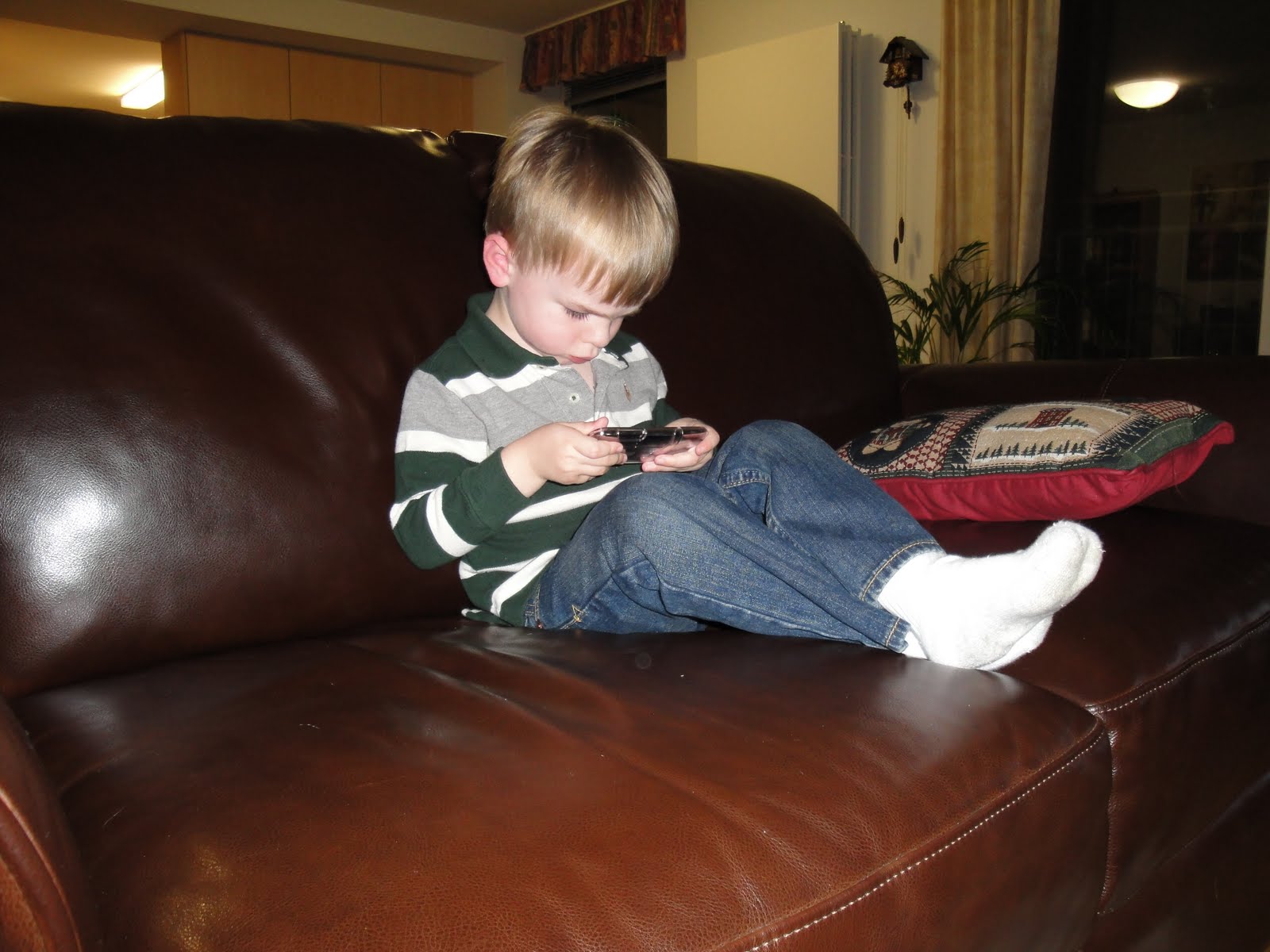
Too young for tech?  I’m not sure I know what that means, but I hear the discussion all around me at work and on the web.  I know this:  I routinely lose control of my iPod Touch to my three year old.  What does he do with it?  If you ask him, he’ll tell you one of two things:  he needs to kill bad guys, or he wants to play “hoopa-loops”.  In both cases he’s referring to a couple of games I have on the Pod.

When I have the chance, I’ve joined the discussion and asked what people mean when they make statements about our little ones being “too young” for access or exposure to a variety of technology.  What the discussion eventually turns to is either content or cost.
The matter of content is pretty straight forward.  Allowing kids access to age-appropriate content while working to keep them away from inappropriate content is nothing new.  It was true with radio prior to television (even though I get the distinct impression the problem was simpler at that time), then with the proliferation of television and the broadening of its associated content, and now today with the web.  But nothing’s really changed; as parents we want to foster and fuel the development of our kids’ minds, but also want to protect them from things that’ll cause harm whether in print, through audio or video.
Darn it, this is complicated.  While it’s appropriate to lump kids of certain ages together for all the right reasons, every kid is still unique.  And so are parents, home environments, neighborhoods, etc.  Macro “rules” for exposing kids to a variety of things only apply on a macro level.  Dads, or at least for this dad, the real work for is the complexity of making these generally wise rules apply very specifically to each of our kids, to do it in concert with our spouses if there is one, and to juggle how this plays out when we have multiple kids in the household.  Ah, the historic friction between older and younger siblings--does access to technology complicate it?  (I can hear it now, “Dad, how come he gets an iPod and I don’t?”)  Content matters and each child is clearly different whether we’re talking about our own kids, or our kids relative to their friends.   And the access to the breadth of content out there through today’s computers is faster and fuller.
As for cost, it often comes down to this:  will I hand an expensive piece of tech to my child knowing he may very well break it?  Nothing special there: kids break things, even expensive things.  I can’t afford for my son to destroy something expensive.  Sorry son, you can’t play with this.
I guess I’m generally comfortable with how my son currently interacts with a variety of media through the TV or web.  My wife and I control it well (so far).  The question I still wrestle with though:  is today’s tech simply this generation’s version of the TV babysitter, or is it more complicated than that?  Does anyone remember the HBO series “Dream On”?  Hilarious, but an interesting commentary about a child raised by the television.  If we’re tempted to use tech, and specifically the web as a babysitter without real oversight, I wonder if we’re at risk of building the next generation of Martin Tuppers?  I’m reminded every day as my wife and I raise our son that parenting is complicated, a full-time job, and it’s just plain hard.  But we enjoy it; it’s also incredible fun for both of us, for Steph as a mom, and for me as a dad.
It’s great to be a dad!